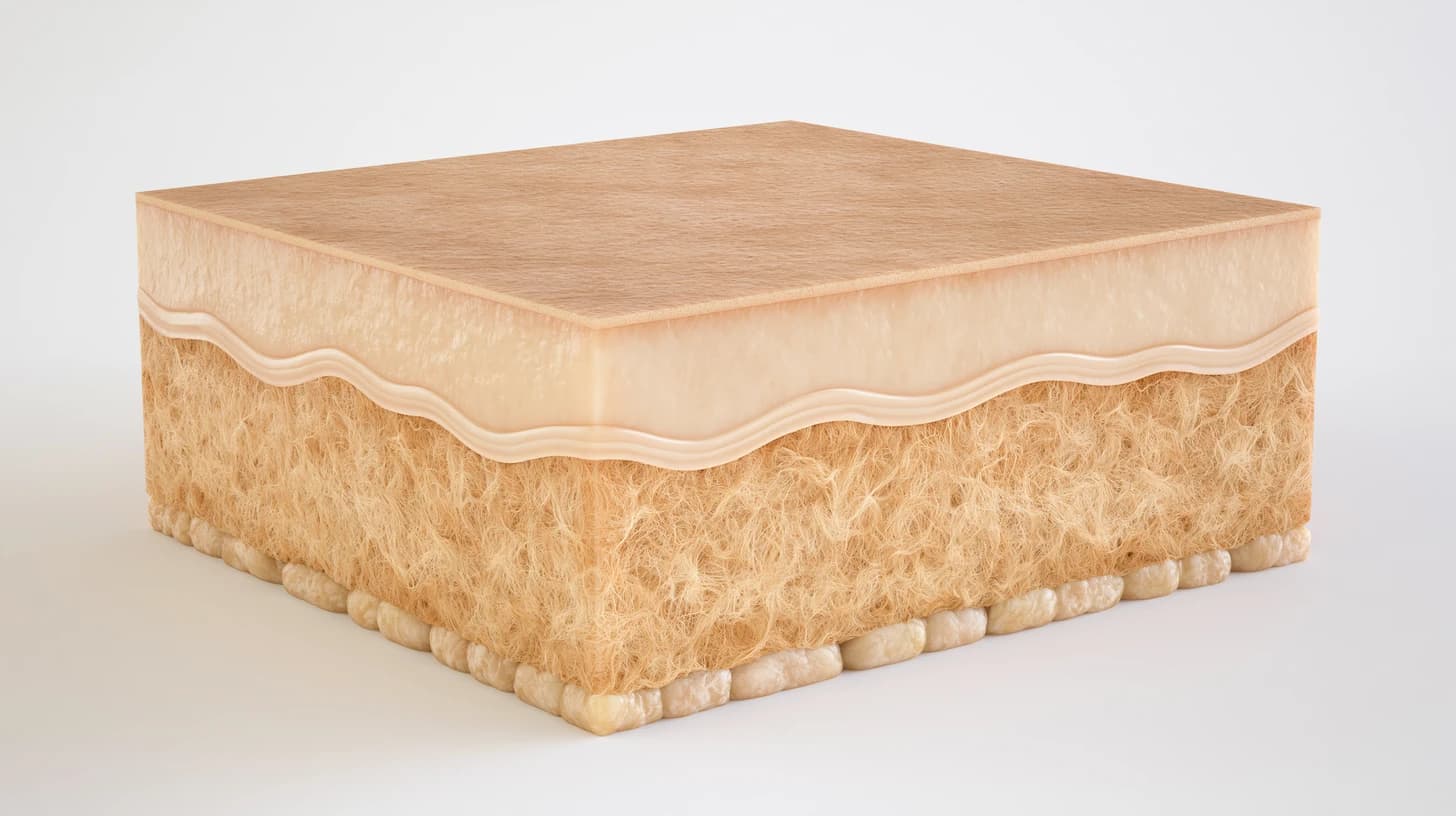
Most skin boosters work by delivering an ingredient that prompts the skin to build collagen. Juveacell takes a different route. Cells are stripped from donated human dermis and the remaining matrix — hADM, human acellular dermal matrix — is placed into the skin, giving your own cells a structure to move into.
This is the follow-up on the supercritical CO2 process promised in an earlier column. What follows reflects how the treatment is performed at Coco Clinic. Results and duration vary between individuals.
What is the matrix that Juveacell places?
Pinch the skin and it returns. That resilience does not come from the cells. It comes from what fills the space between them — collagen, elastin and other fibrous proteins woven into a net. Together this is the extracellular matrix, or ECM.
With age, collagen and elastin decline and that net grows sparse. Skin thins, hollows fall into shadow, and creases stop springing back.
Most anti-aging treatments aim at the same target: collagen renewal. Until recently they nearly all worked by signalling for it.
A second approach places the ECM structure itself rather than an ingredient. Where does such a matrix come from? Human dermis is donated, the cells are taken out, and the ECM framework is left standing. That material is hADM. It is what Juveacell uses.
How does Juveacell work?
Starting from how the material is made:
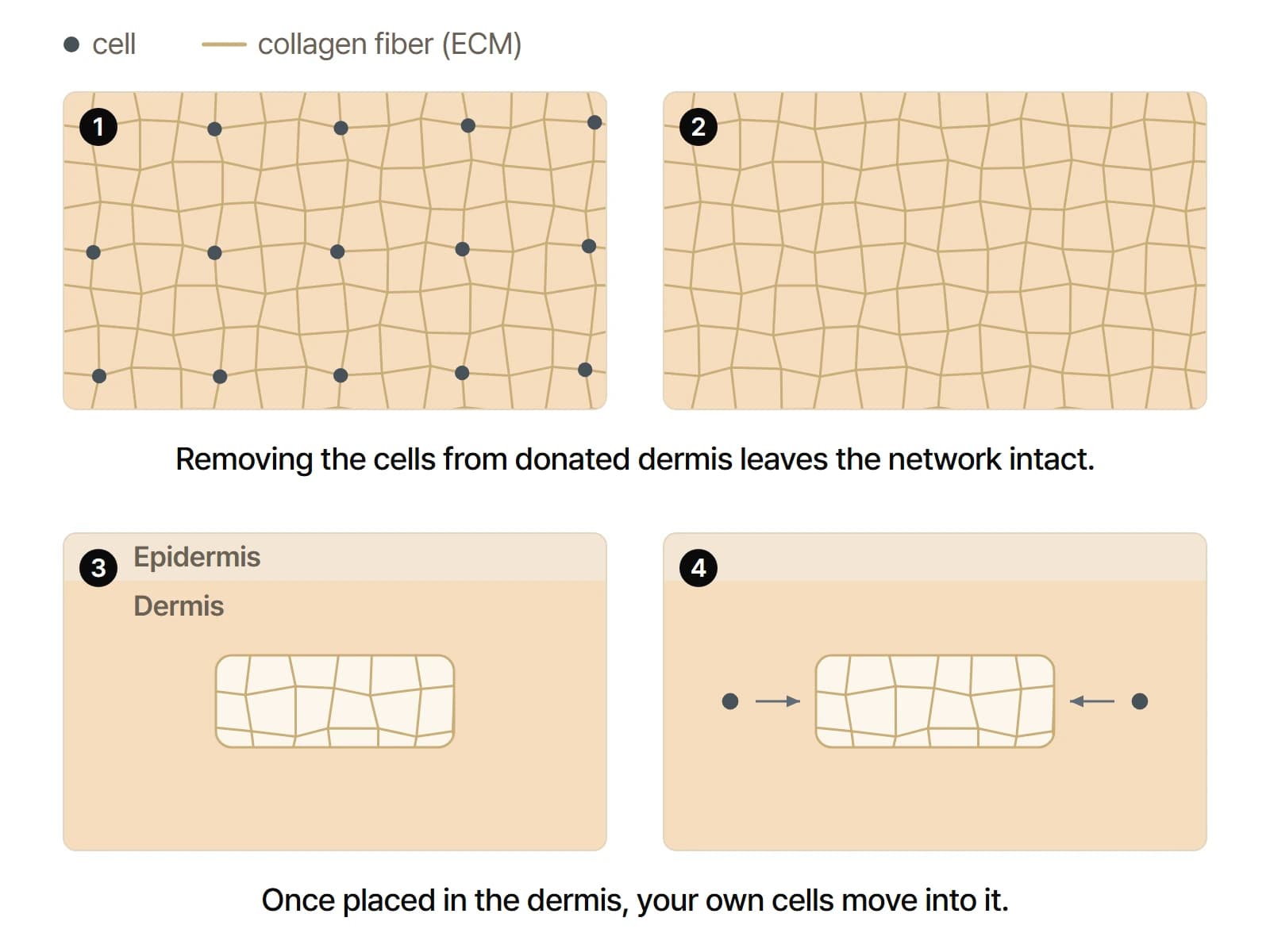
First, the cells come out. Cellular components that could provoke rejection or infection are cleared from the donated dermis. How completely they are removed is what determines the safety of the material.
Second, the structure stays. The dermal ECM framework is held intact while the cells are stripped, and the shape of collagen, elastin and the other key proteins has to survive the process. What is left is structure without cells.
Third, it goes into the skin. For full-face treatment it is injected shallowly across the dermis; for thin, delicate areas such as under the eyes we use a blunt-tip cannula.
Fourth, your own cells move in. Fibroblasts from the surrounding tissue migrate into the settled matrix. In a 2022 review of the clinical uses of acellular dermal matrix, Petrie and colleagues describe this sequence — the implanted matrix is repopulated by host cells, after which collagen and elastin increase and new vessels form.
Think of a house stripped back to its walls and beams, with new residents moving in.
What is the supercritical CO2 process?
It removes the cells with carbon dioxide instead of a detergent.
There is more than one way to strip cells out. The common method dissolves the cell membranes with a surfactant and washes them away. It is a reliable method, but there is a cost: what dissolves cells can also act on the proteins that were meant to stay, and traces of the chemical can remain after rinsing.
Juveacell uses no surfactant. Carbon dioxide held at a particular temperature and pressure enters a state where it spreads through tissue like a gas while dissolving material like a liquid, and in that state it carries the cellular components out. The same process is used to decaffeinate coffee beans, among other long-standing industrial uses.
What matters is that it runs at low temperature. Less heat means less damage to the structure that has to survive. Giang and colleagues reported in 2024 on a supercritical CO2 process that is intended to preserve more of the ECM than surfactant methods; in the animal work in the same paper, inflammatory signalling fell and fibroblasts were seen infiltrating the matrix over time with new collagen forming. That work was preclinical, and the same results have not been shown in human faces.
For a material like this, how it was made counts as much as what it contains. The process effectively defines the product.
When does it show, and how long does it last?
In our practice the change tends to appear relatively early. A booster that signals has to wait for the skin to respond and build new tissue; a matrix takes up its structure the moment it is placed. How much of a change is felt, and when, differs from person to person.
Duration is generally around three to six months, again varying with the area and the condition of the skin. In our practice, satisfaction after a single session tends to be high enough that a course of repeat treatments is often not assumed from the outset — which sets it apart from boosters built on accumulation.
Where is Juveacell used?
It is considered particularly for areas that are thin and delicate enough to make other approaches difficult.
- Under the eyes — hollowing, dark circles, fine lines. The skin here is thin enough that lumping or a bluish show-through is a real concern, which has long narrowed the options.
- Neck lines — thin skin in constant motion, so results are hard to hold.
- Pores and depressed scars — replacing structure where tissue has sunk and casts a shadow.
- Full face — placed shallowly and evenly through the dermis for overall texture and density.
Nodule formation — lumps that can be felt after treatment — has not been a feature of our experience with it, though published data specific to this product are limited. The material comes from human dermis and its cells have been removed, which is related to how little foreign-body or immune reaction it tends to provoke.
Dose and technique change with the area and the goal, so the specifics are settled in consultation. → More on Juveacell
How is it different from other boosters?
There are many boosters, and rather than one being better, they suit different targets and last for different lengths of time.
| Treatment | What is placed | Duration |
|---|---|---|
| Rejuran | PN (polynucleotide) | duration accumulates with repeat sessions |
| Juvelook | PDLLA (biodegradable polymer) | around 12 months |
| Juveacell | hADM (human dermal matrix) | 3-6 months |
| Hilo Wave | HA (hyaluronic acid) complex | 3-6 months |
| Radiesse | CaHA (calcium-based) | 12-18 months |
Lasting longer does not make a treatment better. What each one addresses is different, which is why the durations differ, and comparing the numbers alone leads the judgement astray. → Skin Boosters in Korea: What Each Type Actually Does
What does the evidence cover for the hADM Juveacell uses?
The material itself is not new. Acellular dermal matrix has been used for decades in burn care, breast reconstruction and periodontal surgery, and the literature has accumulated accordingly. The Petrie review cited above summarises it.
Injecting it into the face is recent. Sclafani and colleagues reported in 2000 that micronized matrix placed in facial soft tissue was infiltrated by host fibroblasts without a foreign-body reaction, and work has continued since — but the studies remain small, with short follow-up.
So the evidence here concerns a material and a process. It is not a claim that one product outperforms another; it describes how this approach works.
How is human tissue regulated?
The source dermis is classified in the United States as a human cell and tissue product (HCT/P), regulated by the FDA, and processed by tissue banks accredited by the American Association of Tissue Banks. In Korea, human tissue is overseen through tissue-bank licensing and import approval.
Processing removes the cellular components capable of provoking rejection or infection, and the supercritical CO2 method further reduces chemical residue. Reactions after treatment are reported at the level common to any injection — temporary redness, swelling, bruising.
Because this is a treatment that uses human tissue, we recommend keeping the longer term under regular review.
In summary
Juveacell places a matrix modelled on the structure of the dermis so that your own cells have somewhere to work. The supercritical CO2 process is the choice that removes the cells while disturbing that structure as little as possible, the effect is generally held to last three to six months, and it is considered above all for thin, delicate areas.
The right approach depends on whether the underlying problem is the condition of the skin or its structure, so it is worth confirming in consultation.
References
- Petrie K, et al. Clinical applications of acellular dermal matrices: A review. Scars, Burns & Healing. 2022. doi:10.1177/20595131211038313 (opens in a new window)
- Sclafani AP, et al. Evaluation of acellular dermal graft in sheet (AlloDerm) and injectable (micronized AlloDerm) forms for soft tissue augmentation. Clinical observations and histological analysis. Archives of Facial Plastic Surgery. 2000. PMID 10925439 (opens in a new window)
- Giang NN, et al. Supercritical carbon dioxide decellularized dermal matrix. Frontiers in Bioengineering and Biotechnology. 2024. doi:10.3389/fbioe.2024.1407797 (opens in a new window) (study authors include employees of the manufacturer)
- U.S. FDA. 21 CFR Part 1271 — Human Cells, Tissues, and Cellular and Tissue-Based Products. eCFR (opens in a new window)
Keywords
FAQ
Location
Consultation
Have questions?
Find the treatment and settings that fit your skin — book a consultation at COCO Clinic.