
Skin boosters are injectables that change the condition of your skin rather than its shape. The useful question is not what is in the syringe but what you want the skin to do: if the main complaint is inner dryness and firmness, look at the hydrating group; if it is texture, fine lines and redness, look at the repair group; if it is thinness, pores or scars, look at the collagen-building group. Results vary from person to person, and most of these are courses rather than one-off treatments.
What is a skin booster, exactly?
A skin booster is an injectable placed into the dermis to improve the skin's condition — hydration, texture, density — rather than to add volume or change contour.
That single sentence hides a lot of variety. The products grouped under this name work through completely different materials, and they ask the skin to do different things. This is why "which skin booster is best" has no answer, and why the same person can be told three different things at three clinics without any of them being wrong.
What they do share: the material goes into the skin, not onto it, and the change builds over weeks rather than appearing the day you leave.
Skin boosters vs fillers and Botox — what's the difference?
These two come up constantly in the same conversation, and neither of them is a skin booster.
Fillers work by occupancy. The material itself takes up space, so it changes shape and contour. A booster is not trying to occupy space — it is trying to change what the tissue around it does.
Botulinum toxin works on muscle. It reduces the pull of a muscle so the skin above it creases less. As a skin-botox treatment it also helps texture and pores, and pairing it with a low-molecular-weight hyaluronic acid injection — as we do — eases some of the dryness too. But that is not the same as changing the skin's underlying condition: the effect still comes from the muscle, not from the dermis, which is the actual reason it is not a skin booster.
Which skin boosters hydrate and remodel the dermis?
This group puts water into the dermis and works on texture and firmness, without setting out to create volume.
Hilo Wave binds hyaluronic acids of different molecular weights into a single complex. The heavy fraction holds water and gives structural support; the light fraction signals fibroblasts, which is how it is designed to support collagen and elastin production. It is given as a course of 2 sessions 4 weeks apart. Hydration and glow are felt almost immediately, while the collagen effect peaks at around 2 to 4 weeks.
Belotero Revive reaches a similar goal by a different route. It pairs hyaluronic acid, which draws water in, with glycerol, a moisturising factor the skin makes itself, which holds onto it. The gel is made to spread evenly through the tissue rather than sit in one spot, so what changes is skin quality, not volume. It goes into the dermis through a very fine needle, split across many small points, in a course of 2 sessions 4 weeks apart, with the effect building from about 2 weeks.
Neither is meant to fill a hollow, and how much difference you notice depends on where your skin starts.
Which skin boosters restore the skin's repair environment?
This group does not add a structural material so much as change the conditions the skin repairs itself under.
Juveacell works through human acellular dermal matrix (hADM). Rather than stimulating collagen with an active ingredient, it places a scaffold: donor dermis with the cells removed and the extracellular matrix — the collagen and structural proteins that give skin its framework — left intact. Fibroblasts migrate into that framework and regenerate inside it, which is why it is considered where the skin is short on structure to begin with — thin, delicate areas such as under the eyes and the neck. The cells are removed with supercritical CO₂ rather than detergents, so what is left behind is the matrix itself.
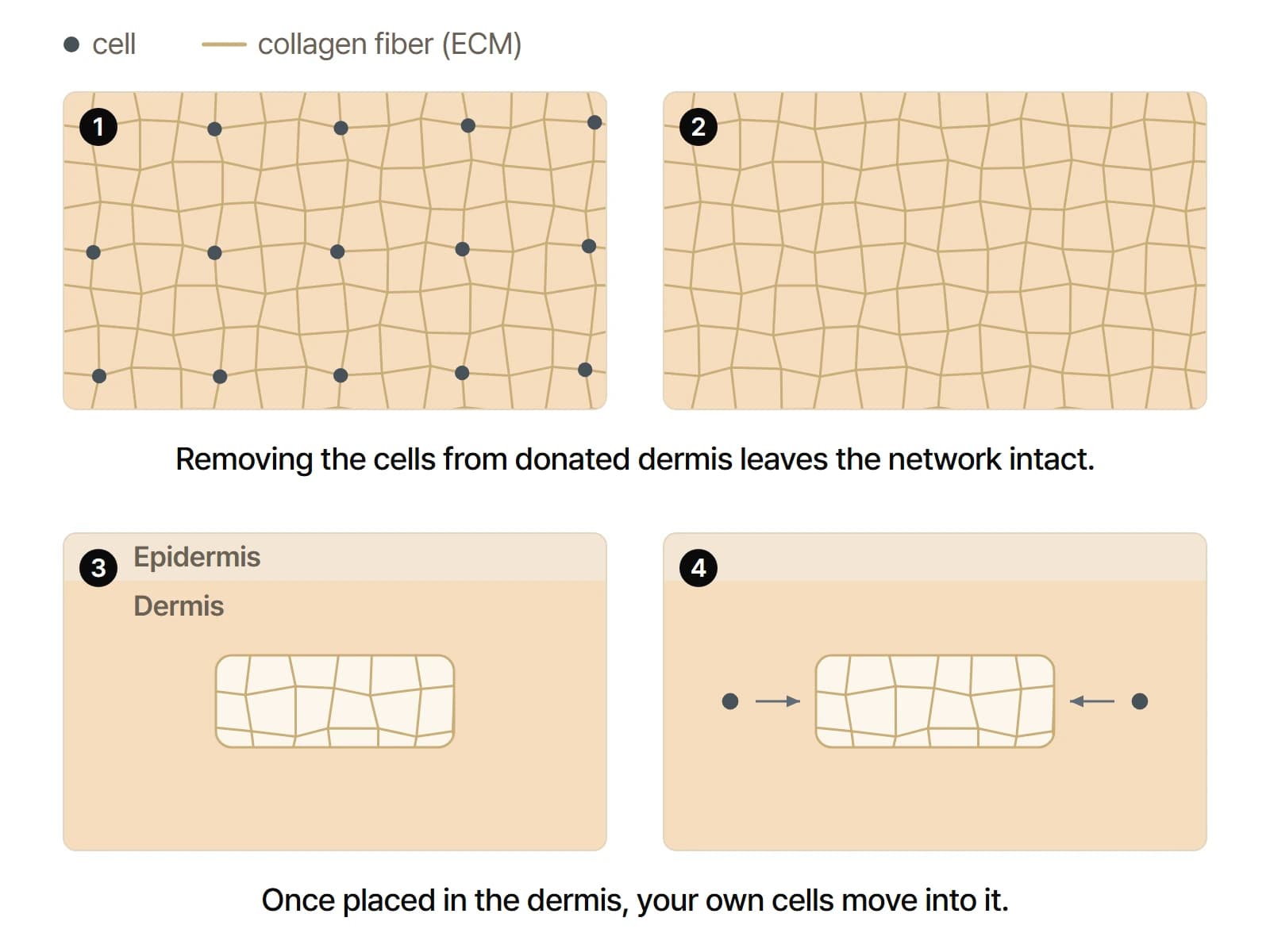
Practically, it is a shallow dermal injection over the full face and is placed with a cannula under the eyes, and it tends not to form nodules. It is also the one treatment in this section that often does its work in a single session, with an effect lasting around 3 to 6 months.
Rejuran uses polynucleotide (PN) purified from salmon DNA (Oncorhynchus keta); the wider PN/PDRN class is also sourced from trout. Placed in the dermis, it raises fibroblast activity so the skin replenishes its own collagen and elastin, and it is also used where redness and sensitivity are part of the picture. It is a course rather than a single treatment: 3 to 4 sessions 4 to 6 weeks apart, with most people noticing the difference from the second or third. A fish allergy must be disclosed before treatment, and bruising is possible, so leave a week or two before anything important.
Both work on the state of the skin itself, and both vary between individuals. Which one is suggested depends on what your skin is short of, and on whether you have time for a course.
Which skin boosters build collagen?
These use a particle that breaks down slowly, and the skin lays down collagen while it does. The material goes; the collagen it prompted stays.
Juvelook pairs PDLLA microparticles with hyaluronic acid. The hyaluronic acid gives the immediate hydration and is absorbed within weeks; the PDLLA breaks down gradually, and it is that slow breakdown that prompts fibroblasts to make collagen. The usual course is 2 to 3 sessions, and the change builds over 6 to 12 weeks rather than arriving at once. You will be asked to massage the area yourself for the first few days.
Radiesse is mostly used diluted as a collagen booster, and that is how we use it. Its calcium hydroxyapatite (CaHA) microspheres sit in a gel; there is a little fullness right after, but diluted it does not fill the way a filler does — fibroblasts attach directly to the CaHA microspheres and are stretched, which raises their activity, so over the following months the skin mainly becomes thicker and firmer. The gel is absorbed over roughly 2 to 3 months and the CaHA breaks down eventually too, but the collagen built in that place stays. One thing to know before choosing it: there is no dissolving agent — hyaluronidase does not work on CaHA — so the amount and the depth are kept deliberately conservative. It is not used in the lips, and not recommended under the eyes.
How much collagen you build is individual, and in this group the answer is meant to arrive slowly.
Is the "salmon sperm facial" the same as an injection?
No — and the difference is depth.
The name covers two different things online. One is a product you apply to your skin; the other is an injection, and Rejuran is the injection — polynucleotide placed into the dermis with a needle, the layer where fibroblasts live and collagen is built. A product applied to the surface does not reach that layer, which is why the two are not versions of the same treatment and a course of one does not replace the other.
The material itself is refined and purified, not raw — the popular name is memorable rather than descriptive.
And what the injection is for is the condition of the skin itself: texture, fine lines, redness. If what is actually bothering you is thin, delicate skin or a lack of structure, the answer may be a different one from this list.
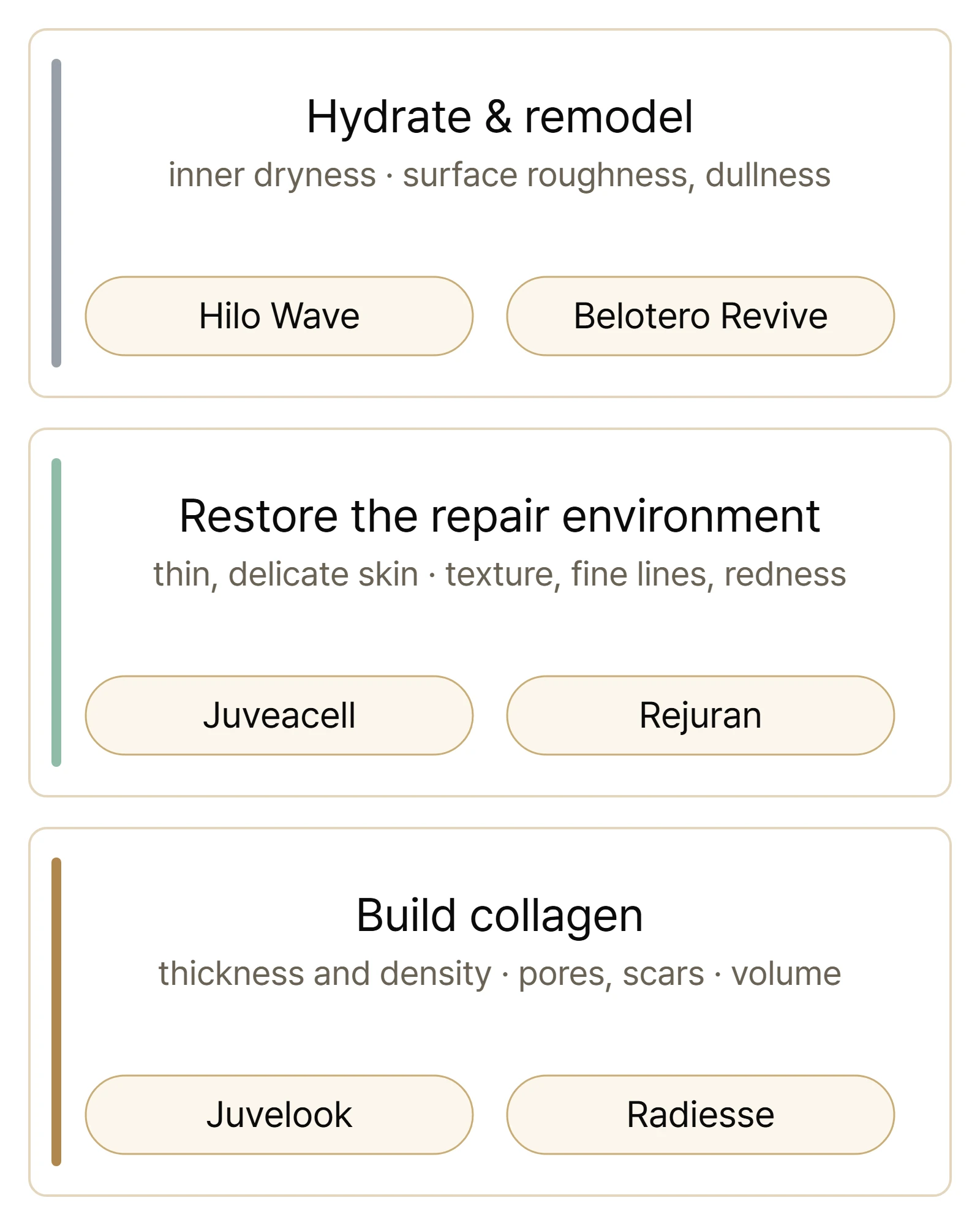
How do the skin boosters compare side by side?
| Treatment | How it works | What it does |
|---|---|---|
| Juveacell (hADM) | Places a matrix scaffold with the cells removed | Fibroblasts migrate in and regenerate inside it |
| Hilo Wave (HA complex) | Hyaluronic acids of two weights hydrate and signal fibroblasts | Inner hydration together with structure |
| Belotero Revive (HA + glycerol) | HA draws water in, glycerol holds it | Surface hydration and smoothness |
| Rejuran (PN) | Raises fibroblast activity in the dermis | Skin rebuilds its own collagen and elastin |
| Juvelook (PDLLA) | The particle breaks down slowly and the skin makes collagen | Skin builds density over weeks |
| Radiesse (CaHA) | Diluted; fibroblasts attach to the microspheres and are activated | Thicker, firmer skin over months — a little fullness at first, not filler-like |
These are not better-or-worse options; they do different jobs, and the actual choice is made in consultation based on your skin and your goal. In particular, a longer-lasting treatment is not a superior one — the treatments differ in the area and the goal they address, and comparing them on duration alone would be misleading.
How do you choose, based on what's bothering you?
Stop at the line that sounds like your own complaint.
- Areas short on structure, or thin and delicate skin such as under the eyes and neck: hADM (Juveacell)
- Inner dryness and structure together: HA complex (Hilo Wave)
- Surface hydration and smoothness: HA with glycerol (Belotero Revive)
- Texture, fine lines, redness — the condition of your skin itself: polynucleotide (Rejuran)
- Thickness and density, pores and scars: PDLLA (Juvelook)
- Firmness of thinning, slackening skin: CaHA (Radiesse)
Most people arrive with two of these at once. That is normal — it becomes a question of sequence rather than of picking a winner.
If you're visiting Korea, how should you plan it?
Honestly: for most of this list, one trip is not a full course.
Rejuran runs 3 to 4 sessions 4 to 6 weeks apart, Hilo Wave and Belotero Revive are 2 sessions 4 weeks apart, and Juvelook is usually 2 to 3. None of those fit inside an ordinary holiday, and one session of a course will not show you what the course does.
Juveacell is the exception: it often does its work in one session, so it fits inside a single trip.
What a single trip can do is a first session and a consultation about what the rest would look like. After you fly home we follow up on WhatsApp and LINE — how the first session settled, and when the next one should be.
In summary
Skin boosters are not one treatment with different brand names on it. They divide into three jobs: hydrating and remodelling, restoring the skin's repair environment, and building collagen — and fillers and botulinum toxin sit outside all three.
Choose by the job you want done, not by the ingredient or by how long something is said to last. And where a treatment is a course, plan for the course.
Keywords
FAQ
Location
Consultation
Have questions?
Find the treatment and settings that fit your skin — book a consultation at COCO Clinic.