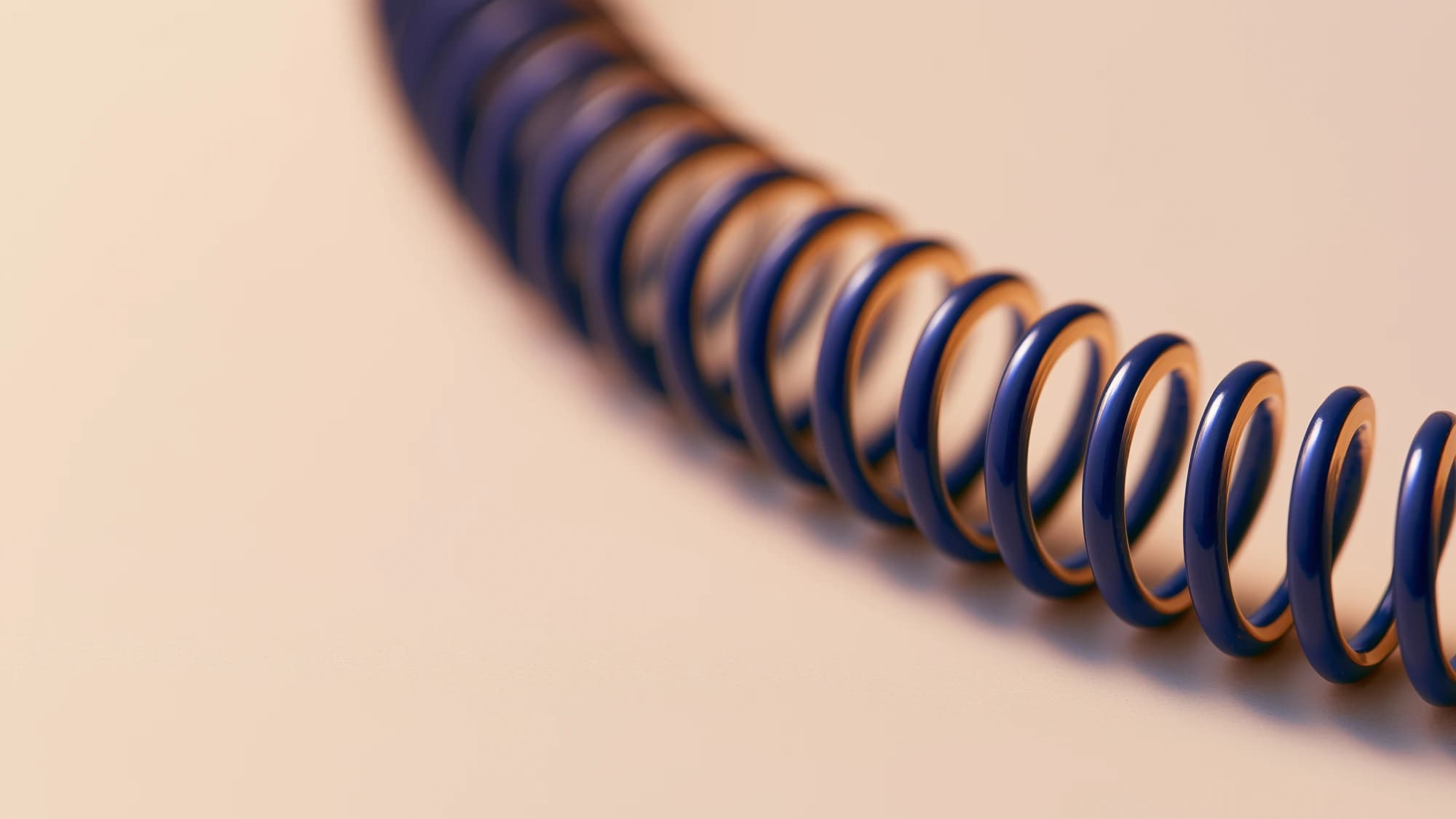
Not every thread lift works by pulling. Jamber lifting uses a dedicated thread — about 35.3cm of PDO compressed into a spring roughly 3.0cm long — placed under the skin. It does not pull. The coil settles into position, and the volume and elasticity it creates fill a hollow and support the skin from below.
That gives the result a different character. Rather than reshaping the outline of the face, it is closer to filling an area that had sunken into shadow and supporting it naturally.
What follows is based on the treatment as we perform it at COCO Clinic. Recovery and how long the result lasts vary with skin condition and treatment area.
Do all thread lifts work by pulling?
No. Thread lifts differ according to what the thread actually does.
The familiar cog (barbed) thread lift uses barbs along the thread to grip tissue and pull sagging skin upward. Jamber has no pulling structure. The compressed spring occupies space beneath the skin and holds that space open, so although both are called thread lifts, they work differently.
One point is worth clearing up. Mint Lifting is not a separate category standing alongside Jamber and cog threads; it is one brand of cog thread. The same goes for names like Ultra V and Blue Rose. If you have seen a comparison set out as "Jamber vs. cog thread vs. Mint", that is two families written up as three. What divides threads is not the brand but the shape of the thread.
This is not a matter of one being better than the other. They address different concerns. Skin that is clearly sagging and needs to be physically lifted calls for a different approach than skin that looks saggy because it has lost volume.
What does the Jamber thread look like?
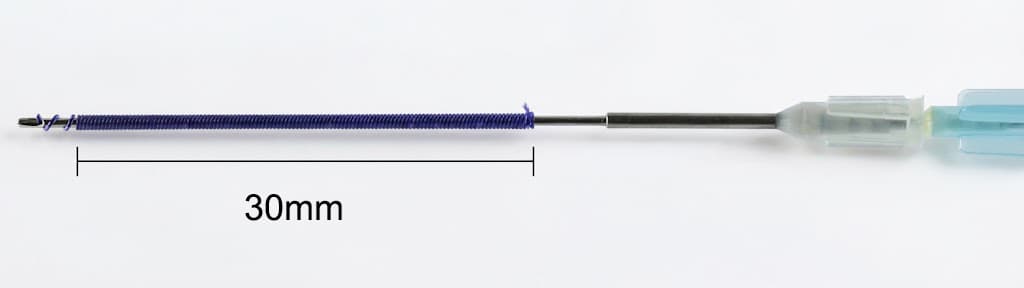
The thread used in Jamber is about 35.3cm of PDO (polydioxanone) compressed into a dense spring around 3.0cm long (23G Jamber F).
Placing the same length of thread straight and placing it compressed give different results. A compressed form concentrates the thread within a short span, so it can create volume, and the coil structure itself has the elasticity to compress and return. That is why Jamber is described in terms of both volume and support.
PDO is an absorbable material long used in surgical sutures. Over time it breaks down and is absorbed by the body.
What does the spring do under the skin?
Three things happen together, and the first two are central.
First, volume. The compressed spring occupies space in the subcutaneous layer and fills a hollow. This is what you notice in areas such as the outer or front cheek, where a sunken contour casts a shadow.
Second, support. Once settled, the spring supports the skin from below and lifts it gently. In construction, the framework that holds a structure up is called a scaffold, and that term is used for Jamber because the thread plays that supporting role.
Third, collagen. PDO has the property of encouraging collagen production in the surrounding tissue. This action is supplementary, however, and is not the main basis for how Jamber works. The result rests on the volume and support the settled thread creates.
What happens when the thread is absorbed?
The result lasts roughly six to eight months, and over that period most of the PDO is absorbed. Because the material is absorbable, the thread does not remain in place indefinitely.
We are careful about what we say regarding any effect remaining after absorption. It is true that PDO helps prompt collagen production, but we do not consider the result to carry on clearly on that basis alone once the thread has been absorbed. If you wish to maintain the result, the treatment can be repeated at intervals of three to twelve months, and the timing is decided in consultation based on your condition.
Which areas does it suit?
We consider it for areas that filler alone does not address well, particularly those that move a great deal with expression.
- Outer cheek — when the outer cheek hollows, the cheekbone and jaw stand out by comparison and the facial line looks uneven. Usually four to eight threads.
- Nasolabial folds — an area with a great deal of movement. Hollowing along the fold and sagging of the front cheek often occur together. Usually four to six threads.
- Front cheek and tear-trough area — results here can easily become excessive depending on how much is placed. Usually two to four threads.
- Marionette lines — considered together with sagging of the deep cheek below the corner of the mouth.
Where several areas are treated together, the thread counts are added. How many threads go where depends on facial structure and the degree of hollowing, so this is best confirmed in consultation. → More about Jamber lifting
What does it cost?
At COCO Clinic it is ₩390,000 for 4 threads and ₩750,000 for 8 threads. Prices shown include VAT.
As noted above we work in 4-8 threads per area, and when several areas are treated together the counts are summed. So it is the total number of threads, not the number of areas, that sets the cost.
How is the treatment done?
The thread comes preloaded in a cannula — a tube with a blunt tip — and settles into place as the cannula is introduced. There is no incision; a needle makes only the small entry point through which the cannula passes. The appointment takes about 20 to 30 minutes including anaesthesia and aftercare, and placing the threads themselves takes less than that.
Anaesthesia combines a topical and a local anaesthetic, with a partial nerve block for the front cheek and nasolabial areas in some cases. Discomfort is greatest during the anaesthetic injection; once the area is numb, most people describe the treatment itself as a feeling of firm pressure. If you are sensitive to pain, numbing cream can be applied first to reduce the discomfort of the injection.
How long is recovery, and when should you book?
Temporary swelling, bruising and tenderness when pressed are possible, but most people return to normal activity within two to three days. Bruising is relatively uncommon, though it can occur since a needle is involved.
If you have an important date, we suggest treating two to four weeks beforehand. Swelling needs time to settle and the threads need time to settle into place before the contour stabilises.
For two to four weeks afterwards, avoid opening your mouth very wide and eating hard foods, and do not massage the treated area firmly. For about a week, avoid prolonged heat such as saunas, along with alcohol and smoking.
How does it differ from cog threads or filler?
These three are not ranked against one another. They do different jobs.
| Jamber (spring PDO) | Cog thread lift | Filler | |
|---|---|---|---|
| Example | Jamber | Mint, Ultra V and other brands | — |
| Method | Compressed spring thread placed subcutaneously | Barbs grip and pull tissue | Volume injected directly |
| What it does | Volume plus support from below | Lifts sagging tissue upward | Fills a hollow |
| When considered | Hollowing and a saggy appearance together | Sagging itself is pronounced | Volume replacement is the goal |
Where sagging is pronounced, energy-based lifting or a cog thread lift is considered alongside. In practice, some plans divide the work — energy-based lifting such as XERF or LinearZ for the sagging, and Jamber for volume and support.
Are there cases where it is not suitable?
The treatment is not carried out during pregnancy, or where there is inflammation or infection at the treatment site. If you have a tendency to keloid scarring, this needs to be checked beforehand.
If you bruise or bleed easily, or take anticoagulant medication, this is usually not a problem as the treatment is carried out with bleeding controlled — but please do tell us beforehand.
In summary
Jamber works through the volume and elasticity of a compressed spring rather than the tension of a thread. It is considered for areas that have hollowed, cast a shadow and therefore look saggy, and the result is taken as lasting about six to eight months, after which it can be repeated as needed.
Even for the same concern, the right approach differs depending on whether hollowing or sagging is the main cause. Which suits you is best confirmed through consultation.
Keywords
Location
Consultation
Have questions?
Find the treatment and settings that fit your skin — book a consultation at COCO Clinic.