Subcision is a treatment that releases the fibrous bands holding a depressed acne scar down from underneath. Many pitted acne scars are not missing tissue: the skin is being pulled inward by scar bands below the surface. When those bands are cut and the space is filled, the tethered skin can lift and new collagen has a place to form. Here we cover subcision for acne scars on the face.
What is subcision, and what does it not do?
Skin subcision is a procedure for depressed acne scars, mainly rolling scars and boxcar scars.
Under local anesthesia, a blunt-tipped cannula is passed beneath the scar and swept in a fan pattern to cut the fibrous bands anchoring the scar floor. The released space is then filled straight away with Juveacell V or Juvelook. At COCO Clinic we do not perform subcision on its own: release and filling are done together in one session.
Subcision does not resurface the skin. It works below the surface, on what is pulling the scar down, which is why it is often paired with a surface treatment such as Legato II at a separate visit.
Which acne scars does subcision treat?
Scars that flatten when you stretch the skin around them.
A simple check: with a finger on each side of a scar, gently pull the skin outward. If the dip smooths out, the scar is most likely being pulled down from below, and subcision can help. If the pit stays as it is, tissue is missing rather than tethered, and a different approach is needed.
| Scar type | What it looks like | Subcision |
|---|---|---|
| Rolling scars | Wide, soft-edged, wave-like dips | A scar type we recommend subcision for |
| Boxcar scars | Dips with sharp edges and a flat floor | A scar type we recommend subcision for. The angular walls can remain, so laser or plasma is considered alongside |
| Ice pick scars | Narrow, deep pits like a puncture | Not suited to subcision. We approach these with Legato II together with Plexr, a plasma device |
In our experience, ice pick scars change little with any method. If someone wants treatment for just one or two ice pick scars, we often advise against it.
Most faces have all three types mixed together. At consultation we first map which type is dominant in each area, then separate the areas subcision can address from those that need something else. Surface texture, pores and marks are often left to Legato II.
Why do some acne scars stay sunken after laser or resurfacing?
Because the reason a scar looks sunken is not always at the surface.
Where acne sat deep in the skin, inflammation damages the dermis, and as it heals, tough fibrous bands can form between the skin and the tissue beneath it. If a band keeps pulling the skin inward, that spot stays dented.
So even when a resurfacing treatment leaves the skin texture smoother, the contour can remain if the pull from below is still there. If a scar's shadow does not go away in side lighting, this kind of tethering is the first thing we consider.
How does subcision work under the skin?
Subcision works in three steps.
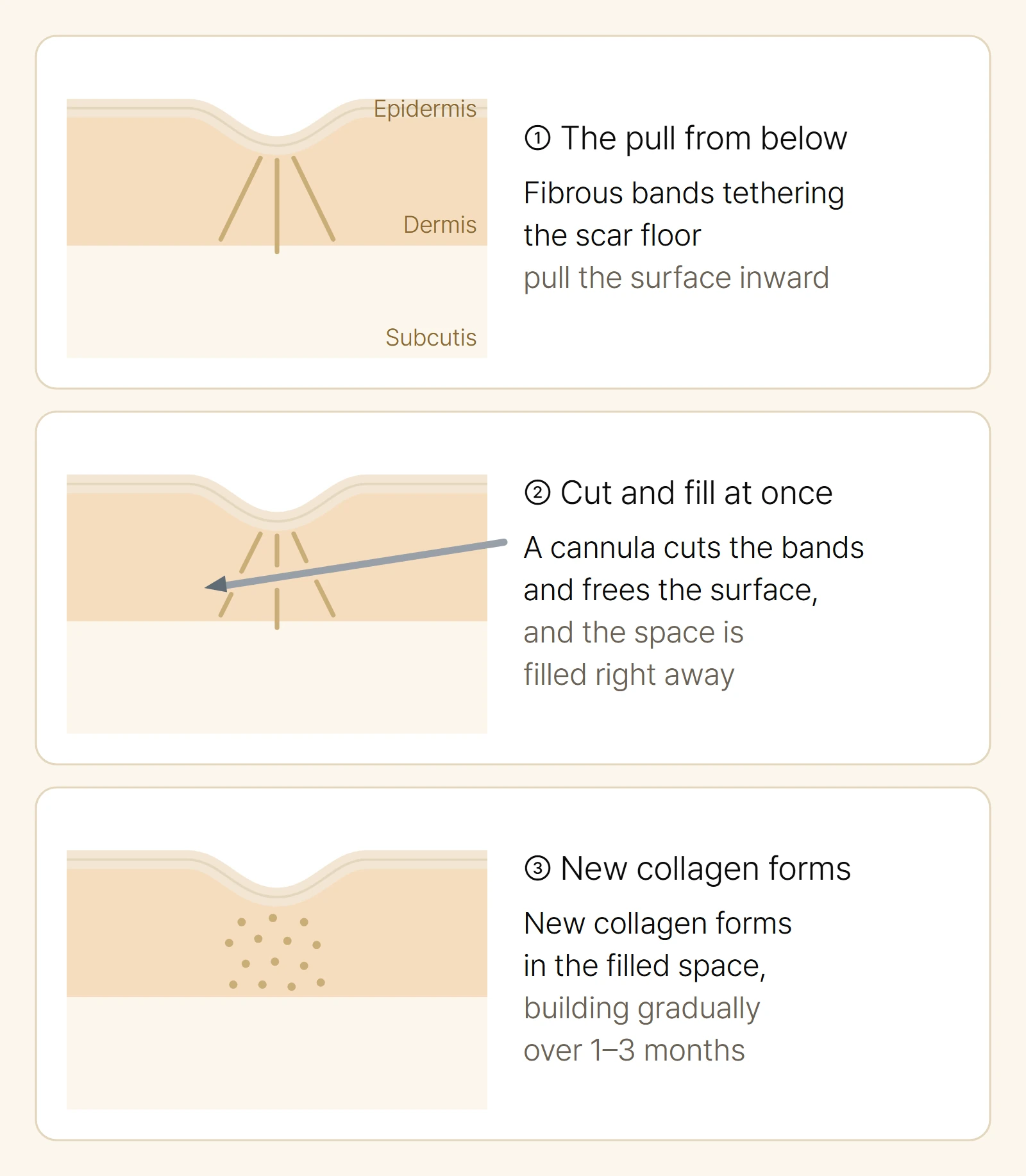
First, the cannula cuts the fibrous bands and releases the pull. Because the tip is blunt, it pushes vessels and nerves aside as it passes, and we work to keep the release within the intended layer.
Second, the space left behind is filled. If that space is left empty, the layers can reattach as they heal and the scar can return to where it was. This is called re-tethering. The filled material acts as a spacer between the layers and helps reduce re-tethering, which is why we fill in the same session rather than waiting.
Third, the release itself signals the tissue to repair, and the filled material stimulates fibroblasts, so new collagen forms in that space. This is the stage at which we hope the scar floor will be supported from underneath, and it builds gradually over 1–3 months.
What is the space filled with after subcision?
At COCO Clinic the space is filled mainly with Juveacell V, and a version using Juvelook is also available.
Juvelook contains PDLLA particles that break down slowly and stimulate collagen production. Juveacell V is made of human acellular dermal matrix (hADM), which acts as a scaffold for regeneration; for facial aesthetic use it is a more recent addition. In subcision both play the same role, filling the space and helping reduce re-tethering.
Which version to use is decided at consultation, based on the condition and extent of the scarring.
Is subcision painful, and what is the procedure like?
Pain is on the higher side, and it is managed with anesthesia.
A session takes about 30–40 minutes, depending on how much area is treated. We first stretch the skin to sort the scars that release from those that do not, and mark the areas to treat. Numbing cream is applied, local anesthetic is injected into the marked areas, and release and filling are done one after the other.
During the release most people feel pushing and pressure rather than sharp pain, but how much you feel varies from person to person.
How long is subcision recovery?
Expect redness, swelling and bruising for about 1–2 weeks.
- Redness, swelling and bruising: common, because bands are cut under the skin. They usually settle over 1–2 weeks, and many people cover them with makeup during that time.
- For at least 2–3 days: avoid alcohol and smoking.
- For 1 week: avoid saunas, jjimjilbang (Korean bathhouses), strenuous exercise and anything else that raises body heat.
- Do not rub or massage the treated area firmly. It can interfere with the filled material settling in.
What you see right after treatment is mixed with swelling, so it is not a good guide to the result. The actual change usually shows gradually over 1–3 months, after the bruising and swelling have gone.
How many subcision sessions will I need?
One session is rarely enough.
Some of the cut bands can partially reattach, so we usually do 2–3 sessions, 2–3 months apart, treating the bands that remain each time. At each visit we reassess the remaining contour once the bruising and swelling have settled. How many sessions you need depends on the extent and depth of the scarring and on how you respond to the first session, and it varies between individuals.
Who should wait or talk to us before subcision?
Treatment may not be possible, or may need a consultation first, if any of these apply:
- You are pregnant or breastfeeding.
- You tend to form keloids or hypertrophic scars.
- There is an infection, inflammation or a cold sore (herpes simplex) in the area to be treated.
- You take anticoagulants or have a bleeding tendency.
- You have an autoimmune condition or a condition that slows wound healing.
In summary
Subcision cuts the fibrous bands pulling a depressed acne scar down and fills the space so the layers are less likely to reattach. It suits rolling and boxcar scars that flatten when the skin is stretched; ice pick scars, where tissue is missing, need a different approach. Bruising and swelling last about 1–2 weeks, most people need 2–3 sessions, and results vary from person to person. Start by finding out which type of scars you have; we can go through that with you at consultation. Treatment options and pricing are on our Skin Subcision page.
Keywords
FAQ
Location
Consultation
Have questions?
Find the treatment and settings that fit your skin — book a consultation at COCO Clinic.