
Sofwave is a non-invasive lifting device in which seven transducers fire ultrasound beams side by side, heating the dermis about 1.5 mm below the skin's surface. Where conventional ultrasound lifting focuses its energy to a point and sends it down to the fascia at 4.5 mm, Sofwave was designed from the start with the dermis as its main target. Why that layer? Because the collagen and other elastic fibers that make up the skin sit mostly in the dermis.
What it is
Sofwave was developed by SofWave Medical in Israel.
The better-known form of ultrasound lifting, though, is HIFU — high-intensity focused ultrasound. HIFU devices like Ultherapy and Shurink concentrate ultrasound at a single point (focusing) and fire it deep into the tissue. Sofwave instead sends out seven parallel beams side by side, a method called SUPERB (Synchronous Ultrasound Parallel Beam).
How it works — the SUPERB parallel beams
Focus ultrasound to a point and the energy concentrates there, but the space between one point and the next is left untreated. SUPERB has seven transducers emit 12 MHz ultrasound at the same instant, heating a layer as a plane rather than a scatter of points. Each pulse covers an area of 1 cm × 4 cm.
The higher the frequency, the shallower ultrasound tends to penetrate. With its high 12 MHz frequency, Sofwave keeps its main target at the 1.5 mm dermis, heating it to 60–70°C for 4–5 seconds per pulse and forming cylindrical zones of thermal coagulation there. The skin then responds through the wound-healing process, actively producing new collagen and elastin.
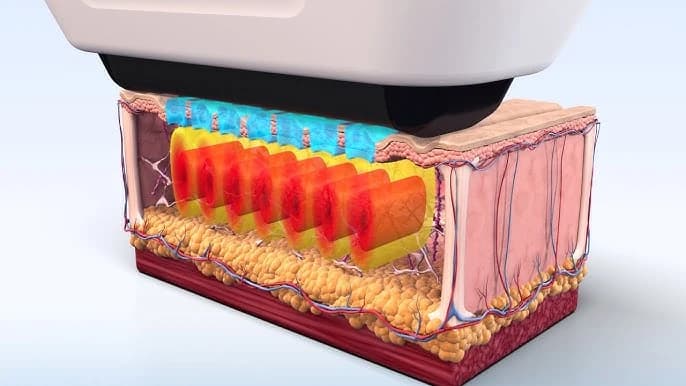
Why does Sofwave target the dermis at 1.5 mm?
Put simply, collagen, elastin, and the skin's other elastic fibers sit mainly in the dermis — and the fibroblasts that produce those fibers are found at high density in the dermis as well.
This is where Sofwave stands apart from the devices that came before it.
Conventional HIFU devices focus their ultrasound energy at comparatively deep targets — 4.5 mm, 3.0 mm. The target there is not the dermis but the SMAS, the fascial layer that lies beneath the subcutaneous fat. By concentrating on the SMAS, HIFU improves sagging — and along the way it also melts away some of the fat layer, slimming the face, which can be an effect or a side effect depending on the patient.
RF devices take a different approach again. Rather than concentrating on a specific depth, their defining feature is bulk heating across the full thickness of the skin. That broad thermal stimulus promotes collagen production evenly, but it does not fit the idea of targeting one particular depth.
Sofwave directs its energy at 1.5 mm, where the dermis sits, and delivers it as a plane rather than a point — a device well suited to stimulating the dermal fibroblasts. And because it does not target the deeper subcutaneous fat, it is comparatively safe from unwanted volume loss.
| Sofwave | HIFU (LinearZ) | RF (Xerf) | |
|---|---|---|---|
| Energy | Ultrasound (parallel beams) | Ultrasound (focused) | Radiofrequency (monopolar RF) |
| Working depth | Mid-dermis, about 1.5 mm | 1.5 · 3.0 · 4.5 mm (down to the SMAS) | Dermis to subcutaneous layer |
| Heat delivery | Covers a layer as a plane | Point-by-point coagulation | Heats a broad volume |
| Main target | Skin thickness and elasticity, fine wrinkles | SMAS lifting, jawline | Overall tightening, contour |
| Reaches subcutaneous fat | No | Depends on depth | Yes |
Who is it for?
It is a good fit for patients whose facial skin is thin enough to make deeper lifting treatments a hesitation, patients who have seen their cheeks hollow after a previous lifting procedure, and patients bothered by fine wrinkles together with a sense that the skin has grown thinner.
At our clinic, we mainly have in mind patients in their 30s and 40s or older who are concerned with fine wrinkles and surface-level elasticity — around and under the eyes, in the lines above the upper lip, and on the neck, for example.
It is by nature a treatment with a real degree of discomfort, and it takes about 30–45 minutes including numbing cream. Treating the full face and neck in one session typically uses 200–300 pulses. → Learn more about Sofwave
For patients whose main concern is overall sagging, or whose faces carry more volume, other treatments such as HIFU or Xerf RF lifting may be a better fit. We recommend settling on the specific treatment after a consultation.
References
- Suh DH et al. (2024). High-Intensity, Parallel Ultrasound Tightening of Facial Skin: Clinical and Pathologic Results. Journal of Cosmetic Dermatology. doi:10.1111/jocd.16670 (opens in a new window) · PMC11845918 (opens in a new window)
- Hongcharu W et al. (2023). The efficacy and safety of the high-intensity parallel beam ultrasound device at the depth of 1.5 mm for skin tightening. Journal of Cosmetic Dermatology. doi:10.1111/jocd.15672 (opens in a new window)
- Wang JV et al. (2023). Eyebrow Lifting From High-Intensity, High-Frequency, Parallel Ultrasound Beams. Dermatologic Surgery 49(7):718-720. doi:10.1097/DSS.0000000000003809 (opens in a new window)
- Gold MH, Biron J (2024). Efficacy and safety of high-intensity, high-frequency, non-focused ultrasound parallel beams for facial skin laxity. Journal of Cosmetic Dermatology. doi:10.1111/jocd.16098 (opens in a new window)
- U.S. FDA (2021). SofWave System 510(k) Summary, K211483 — pivotal study for brow, submental, and neck lifting. accessdata.fda.gov (opens in a new window)
Keywords
FAQ
Location
Consultation
Have questions?
Find the treatment and settings that fit your skin — book a consultation at COCO Clinic.