Masseter Botox slims the lower face by shrinking the chewing muscle. But it only helps when muscle is what's making the face look wide. If your jawline hasn't changed after repeated treatments, the fullness may be coming from an enlarged salivary gland. Botox aimed at muscle doesn't reach it.
Salivary gland Botox is an injection that reduces the nerve signal driving saliva production, so that an enlarged gland gradually loses volume. Below: how to tell muscle from gland at home, what the treatment involves at COCO Clinic in Seoul, and how to time it if you're visiting Korea. Results vary from person to person.
Why didn't masseter Botox slim my jawline?
Usually because muscle wasn't the main cause. Three structures sit close together in the lower face:
- Masseter — the chewing muscle, above the jawline, beside your back teeth. This is what masseter Botox treats.
- Parotid gland — the largest salivary gland, in front of and below the ear, partly overlapping the masseter.
- Submandibular gland — a smaller salivary gland tucked under the lower corner of the jawbone.
When an enlarged gland is the bigger contributor, shrinking the muscle leaves that part of the jawline unchanged. Neither treatment is better than the other; they act on different tissue, and the first step is finding out which one is involved.
What is salivary gland Botox?
Salivary gland Botox is botulinum toxin injected into an enlarged salivary gland to reduce the nerve signal that drives saliva production. If you search the term in English, most of what comes up is medical articles about drooling: the same toxin is an established way to reduce excessive salivation. The cosmetic use relies on the same mechanism with a different goal — with less stimulation to secrete, the gland gradually decreases in volume, which can soften the fullness it was creating.
The change is reversible. The gland becomes smaller rather than disappearing, and it returns toward its original state as nerve function recovers.
How do I tell muscle from gland at home?
Clench your back teeth hard, then release, and notice how the fullest spot changes:
- It bulges and hardens when you clench — muscle. The masseter softens again when you relax, and you'll feel it above the jawline.
- It stays soft no matter how hard you clench — likely gland. Salivary glands sit lower and further back, from below the ear across the jawline. Some people feel the area tighten at the thought of sour food.
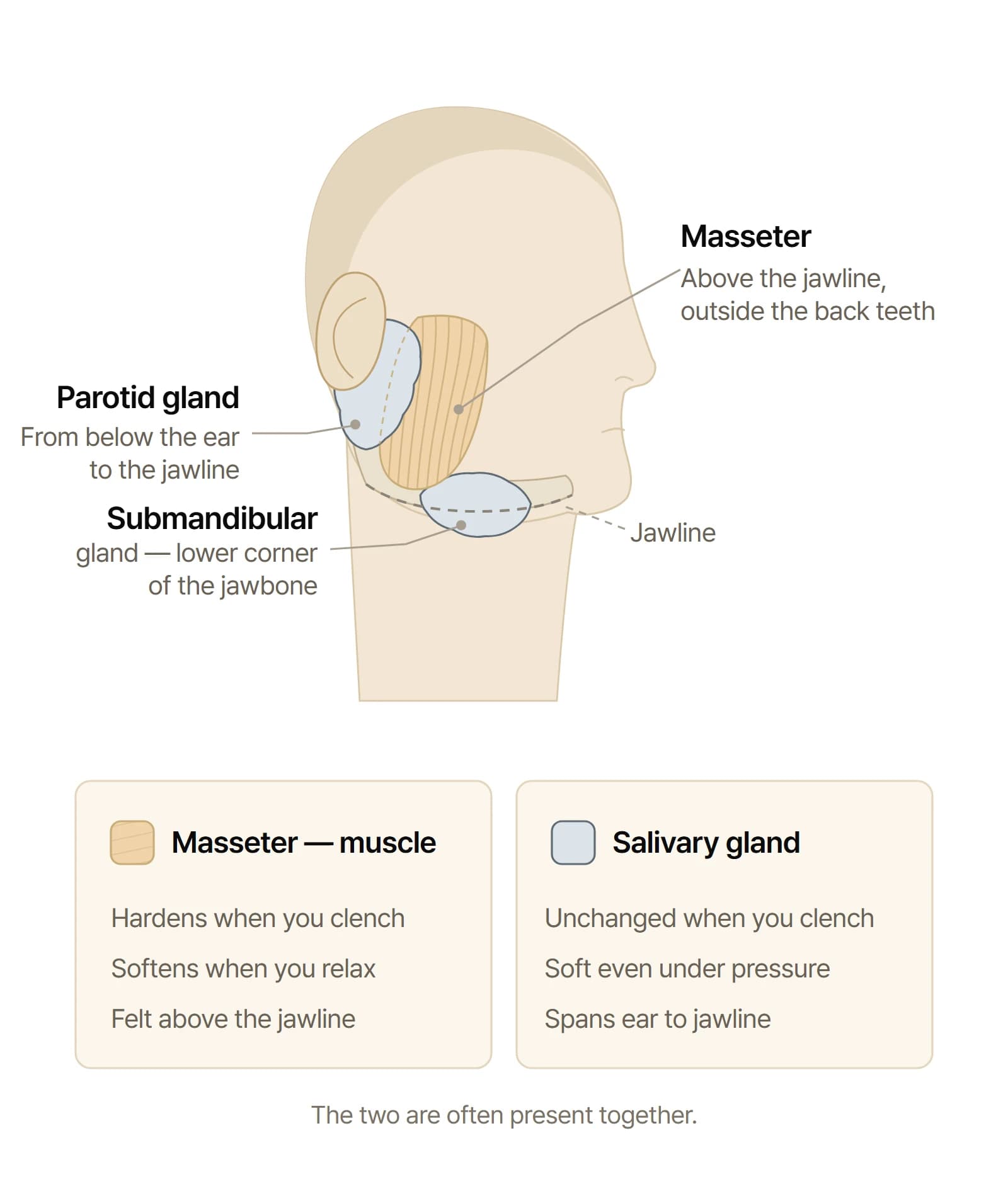
The two often coexist. That's why we check the area by hand, with your teeth clenched and then relaxed: to judge which contributes more, and whether treating the gland is worth doing at all. If the gland isn't a significant part of the picture, we don't recommend this treatment.
How is it different from masseter Botox?
Same drug, different nerve. Masseter Botox works on the motor nerve that drives movement; salivary gland Botox works on the parasympathetic nerve that drives secretion. The mechanism itself is covered in Botox — myths and truth.
| Masseter Botox | Salivary gland Botox | |
|---|---|---|
| Target | Chewing muscle (masseter) | Parotid / submandibular gland |
| Nerve | Motor | Parasympathetic |
| On clenching | Hardens | Stays soft |
| How change comes | Muscle shrinks with less use | Gland shrinks with less secretion |
How long does salivary gland Botox last?
- 1–2 weeks — change begins, gradually
- 4–6 weeks — clearest point; this is when we review size and symmetry
- 4–6 months — typical duration before the gland returns toward baseline
The toxin itself wears off in about 2–3 months; the extra months come from the time the gland takes to recover function and rebuild volume. Duration varies with gland size, dose, and the individual. As with masseter Botox, the reduction tends to accumulate over repeated sessions.
Sessions are usually spaced 6–12 months apart — deliberately longer than the effect lasts, because short intervals raise the risk of the toxin becoming less effective over time.
What are the side effects of salivary gland Botox?
Dry mouth is the first question most people ask. At an appropriate dose, dryness that interferes with daily life is uncommon: saliva comes from several glands, so reduced output in one doesn't stop the others. If the dose is too high, the mouth can feel dry or food harder to swallow — temporarily. Drinking water more often usually settles it.
A temporarily uneven smile is possible if the toxin spreads toward branches of the facial nerve, which run near the parotid gland. This is why injection depth and placement matter, and why we ask you not to rub or press the area for 4 hours afterward.
Avoid alcohol on the day and strenuous exercise for 24 hours. If your smile or expression feels off, contact us right away.
Can I get salivary gland Botox while visiting Korea?
The treatment itself fits a trip easily: the injection takes under 5 minutes, numbing cream is usually unnecessary, and you can go straight back to your day.
The result doesn't. Change is clearest at 4–6 weeks, so you'll most likely be home before you see it. If you're timing it to an event, count back at least 4 weeks — the same logic across other treatments is in timing treatments around a date.
The 4–6 week review doesn't require flying back. We check progress, symmetry, and any dryness over the messaging channel you already use with us — WhatsApp and LINE included.
Keywords
FAQ
Location
Consultation
Have questions?
Find the treatment and settings that fit your skin — book a consultation at COCO Clinic.