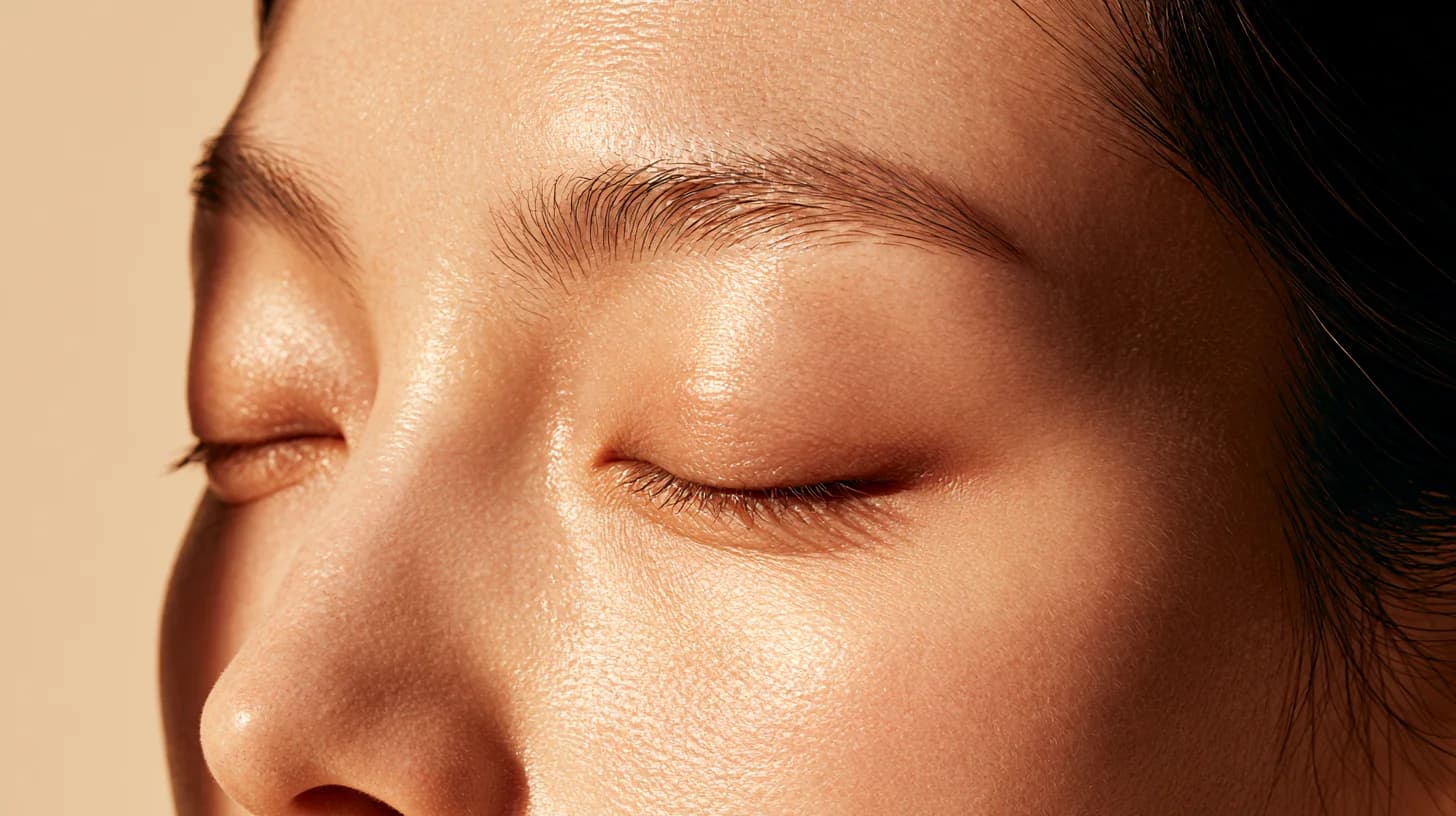
Tens of thousands of times a day, your face receives the same instruction: contract. It travels from the nerve ending to the muscle as a very short chemical letter called acetylcholine. What Botox does is exactly one thing — it keeps that letter from being delivered, closing the mailbox for a while.
So Botox is not a treatment that fills anything. It is the opposite: it subtracts, it pauses, it takes tension away. That may be why the most common aesthetic treatment in the world is also one of the most misunderstood. "Once you start, you can never stop." "It erases your expressions." "It's an injection that fills in wrinkles." Let's begin with those three.
What Botox actually does — the letter between nerve and muscle
Botox is the common name for botulinum toxin. For a muscle to move, the nerve ending must release acetylcholine to deliver the signal to contract. Botulinum toxin cleaves a protein required for that release (SNAP-25), blocking the signal itself. Because it interrupts the nerve–muscle connection chemically and temporarily, medicine calls this chemodenervation.
The key word is temporarily. The cleaved protein is remade over time, and nerve terminals sprout new connections. That is why every Botox result has an end date. It does not remove a muscle permanently. This reversibility is precisely what makes the treatment adjustable and safe.
Not filling, but pausing. Because it can be undone, it can be dialled in.
Wrinkles come in two kinds
It is also a misconception that Botox works on every wrinkle. Broadly, wrinkles fall into two categories.
- Dynamic wrinkles — lines created by muscle movement when you smile or frown. The glabella (between the brows), forehead, and crow's feet are typical. Since excessive movement is the cause, softening that movement with Botox works well.
- Static wrinkles — the creases that remain even with a relaxed face, formed as skin volume and elasticity decline. These are a collagen and volume problem rather than a muscle problem, so Botox alone has limits and other approaches (fillers, regenerative or lifting treatments) are considered alongside.
Botox for movement lines; something else for settled creases. That is why a good consultation asks not "which injection should we use?" but "where did this line come from?"
From face to body — where Botox goes to work
Botox is known as "the wrinkle injection," but in practice it is a broad tool for resting muscles or glands that are working too hard. The main applications:
| Area | What it does | Onset | Duration (varies) |
|---|---|---|---|
| Glabella · forehead · crow's feet | Softens expression lines | 2–7 days | 3–4 months |
| Masseter (square jaw) | Slims an overdeveloped chewing muscle | 2–4 weeks | ~6 months |
| Calves · trapezius | Relaxes overdeveloped muscle to refine the line | 2–4 weeks | ~6 months |
| Underarms (hyperhidrosis) | Suppresses sweat production | 3–6 days | 3–6 months |
| Gummy smile · chin | Adjusts excessive muscle movement | 3–7 days | 3–4 months |
Note that both the purpose and the speed of onset differ by area. Expression lines respond within days, while areas where the muscle's bulk is being reduced — the jaw, the calves — need several weeks for the muscle to gradually atrophy. Masseter Botox is covered in more detail in our muscle reduction treatment guide.
When it appears, and how long it stays
Botox is not a treatment that changes you the moment you leave the clinic. Expression lines usually begin to soften 2–7 days after injection and reach peak effect at around two weeks. Areas where muscle volume is being reduced are slower — visible change can take 2–4 weeks.
Duration also varies by area and by person. Expression lines typically hold for 3–4 months, hyperhidrosis treatment 3–6 months, and masseter treatment often around six months (individual variation applies). The fading is not a failure — it is a designed property. Once nerve connections recover, the muscle begins to move again, which is why maintenance requires repetition.
This is where "once you start, you can never stop" comes from. The truth is closer to the opposite: if you stop, you simply return to your baseline over time — nothing gets worse. That said, with areas like the masseter, repeatedly resting the muscle can produce cumulative atrophy, which sometimes lengthens the interval between sessions.
Natural results come from the map, not the dose
The most common worry: "Will my face look frozen?" The concern is legitimate. But the cause is not Botox itself — it is overdosing and imprecise placement. Too much product, or product in the wrong muscle, is what stiffens expressions or creates asymmetry.
So the standard for good injecting is not how much but where, and how precisely. Even within the forehead, some muscles lift the brow while others create the frown. Reading that anatomical map — leaving the expressions that should stay and subtracting only what is excessive — is the condition for a natural result.
Good Botox does not erase expression. It removes only the excess movement.
That is the principle COCO Clinic follows: the smallest effective dose, anatomically chosen points, and no unnecessary injecting.
What the evidence says
Among aesthetic treatments, Botox rests on a comparatively deep evidence base. The literature below is provided to explain the mechanism and is not a guarantee of individual results.
- A meta-analysis pooling seven randomized controlled trials (1,474 participants) on glabellar lines found that a single standard dose of botulinum toxin A produced clear improvement versus placebo, with no significant difference in adverse-event rates compared with placebo. — Guo et al., Plastic and Reconstructive Surgery, 2015 (opens in a new window)
- The mechanism by which botulinum toxin A cleaves SNAP-25 at the neuromuscular junction to block acetylcholine release is described across multiple studies. — Baskaran et al., Muscle & Nerve, 2014 (opens in a new window)
- In a triple-blind randomized controlled trial on masseter hypertrophy, ultrasound-measured masseter thickness decreased significantly, with the effect greatest around six months and gradually recovering thereafter. — Scientific Reports, 2024 (opens in a new window)
- In a large randomized, double-blind, placebo-controlled trial of axillary hyperhidrosis (320 participants), the response rate at four weeks was far higher with botulinum toxin A than placebo (94% vs 36%). — Naumann & Lowe, BMJ, 2001 (opens in a new window)
- Frequent, high-dose or closely spaced sessions can rarely lead to reduced effect through neutralizing antibodies (secondary non-response), which is why the smallest effective dose and intervals of at least three months are recommended. — Kroumpouzos & Silikovich, JMIR Dermatology, 2025 (opens in a new window)
A checklist for receiving it safely
- Contraindications — Botox is avoided during pregnancy and breastfeeding, and in neuromuscular conditions such as myasthenia gravis; consultation is essential. Treatment is also postponed if there is inflammation or infection at the site.
- Right after treatment — Avoid lying down for about four hours, and do not rub or press the injected area (this prevents the toxin from spreading to unintended muscles).
- First 24 hours — Avoid strenuous exercise, saunas, and alcohol.
- Intervals — Do not rush retreatment. Sessions repeated too frequently (within three months) and unnecessary "top-up" injections can raise the risk of resistance, so the smallest effective dose with adequate spacing is the principle.
- Genuine product, qualified injector — Which product, administered by whom, at what dose, determines both the result and the safety. Authentic product, correct dosing, and an injector who knows the anatomy are the baseline.
Keywords
FAQ
Location
Consultation
Have questions?
Find the treatment and settings that fit your skin — book a consultation at COCO Clinic.