
Radiesse is an injectable made of calcium hydroxylapatite (CaHA) microspheres suspended in a gel. It is licensed as a filler, but in Korea today it is mostly diluted and used as a collagen biostimulator, and that is how we use it: diluted, and spread thinly across the face.
Diluting it changes what it does. It fills less, the particles spread over a wider area, and more of your own collagen-producing cells come into contact with them. There is a little fullness right after the injection, but it does not feel filled the way a filler does. The change that matters arrives over the following months, and it is mainly thicker, firmer skin.
Is Radiesse a filler or a biostimulator?
Both, depending on how it is used.
Radiesse is made by Merz in Germany. It received European CE marking in 2004 and FDA approval in the United States in 2006, and in Korea it was licensed by the Ministry of Food and Drug Safety in 2010 for the temporary improvement of facial wrinkles in adults and for restoring volume to the back of the hands. By classification, it is a filler.
Used undiluted, it adds volume. Diluted and spread thinly, the aim moves from filling to stimulating collagen. That second use is now the usual one in Korea.
CaHA is the same family of mineral that makes up bone and teeth, and it has a long history as a bone graft material in orthopedics and dentistry. Over time it breaks down into calcium and phosphate ions and is cleared. The particles do not stay, but the collagen built around them does.
What is hyperdilute Radiesse?
Hyperdilute Radiesse is Radiesse mixed with more liquid before injection so that it can be spread thinly over a large area. Two things change.
- It fills less. The more it is diluted, the weaker the immediate volume effect.
- It spreads further. The particles cover a wider area, so more cells meet them.
In a laboratory study, fibroblasts that touched the particles produced collagen, and how active each cell became did not depend much on the dilution. Dilution works less by making each cell work harder and more by bringing more cells into contact with particles.
We set the dilution by skin thickness and area, with reference to international expert recommendations. Thin skin, such as on the neck, gets a more dilute mix.
How does Radiesse build collagen?
Fibroblasts are the cells that make collagen. When CaHA microspheres settle in the skin, fibroblasts attach directly to them and are stretched, which raises their activity, and they start producing new type I collagen and elastin.
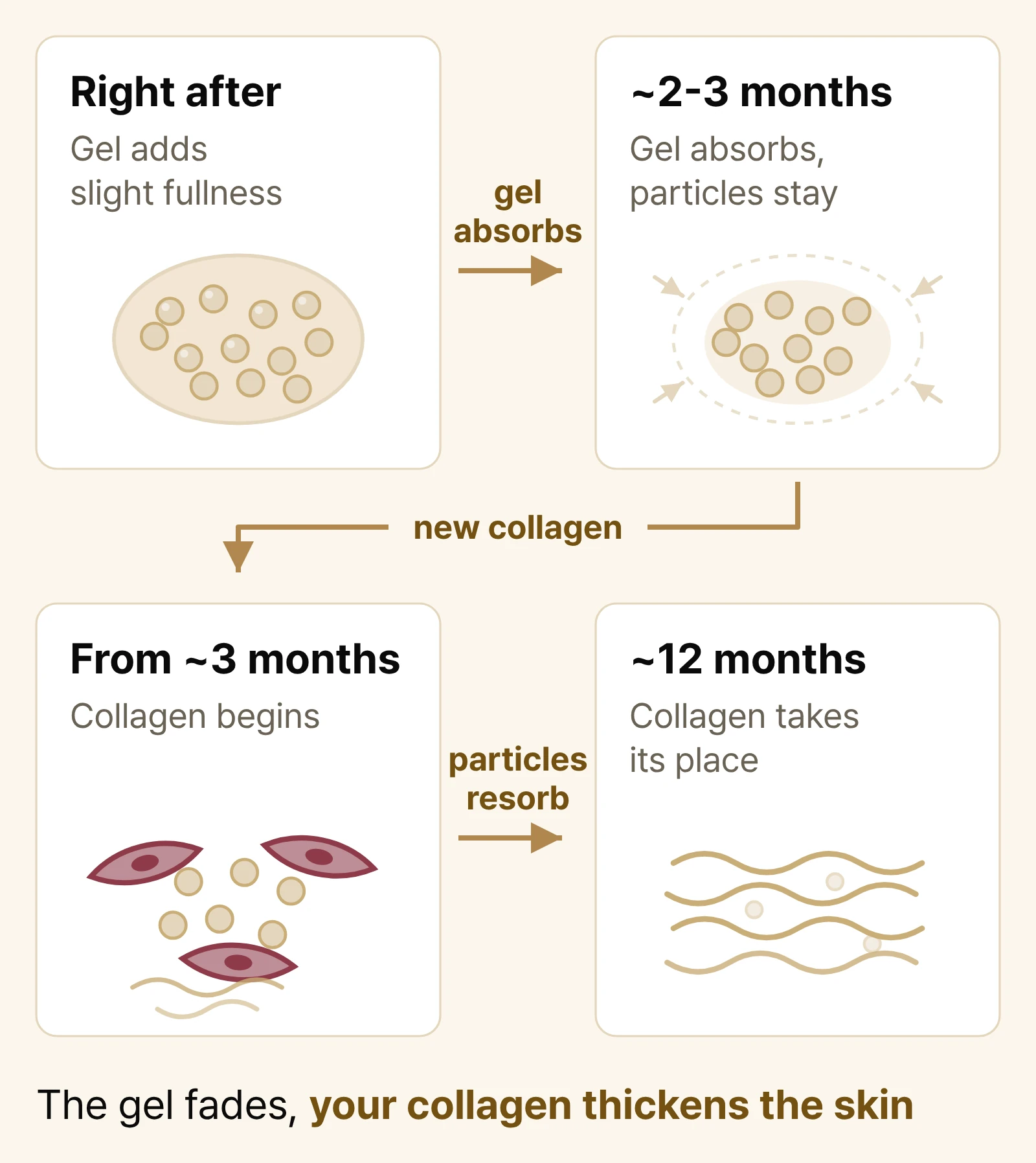
In a biopsy study, collagen and elastin increased together at the treated sites, alongside measured improvements in skin elasticity and in dermal thickness on ultrasound.
How is Radiesse different from Sculptra or Juvelook?
All three get your skin to make its own collagen. The route is different.
- Radiesse (CaHA): fibroblasts attach directly to the calcium microspheres, and that contact switches them on.
- Poly-lactic acid products (PLLA, sold in the US as Sculptra; PDLLA, sold in Korea as Juvelook): immune cells called macrophages respond first, and collagen increases in response to their signals.
We do not offer Sculptra at our clinic; our poly-lactic acid option is Juvelook.
That is a difference in mechanism, not a ranking. Which suits you depends on skin thickness and the area you are concerned about, and that is decided at consultation. In the same area, we would rather do one biostimulator well than two at once.
Why does Radiesse seem to wear off after a few weeks?
This is a question we hear often after treatment.
The slight fullness right after injection comes mostly from the gel that carries the particles. That gel is absorbed over about 2–3 months, and swelling settles over the first 1–2 weeks. So the early fullness dips for a while, and if you are not expecting that, it is easy to think the treatment has stopped working.
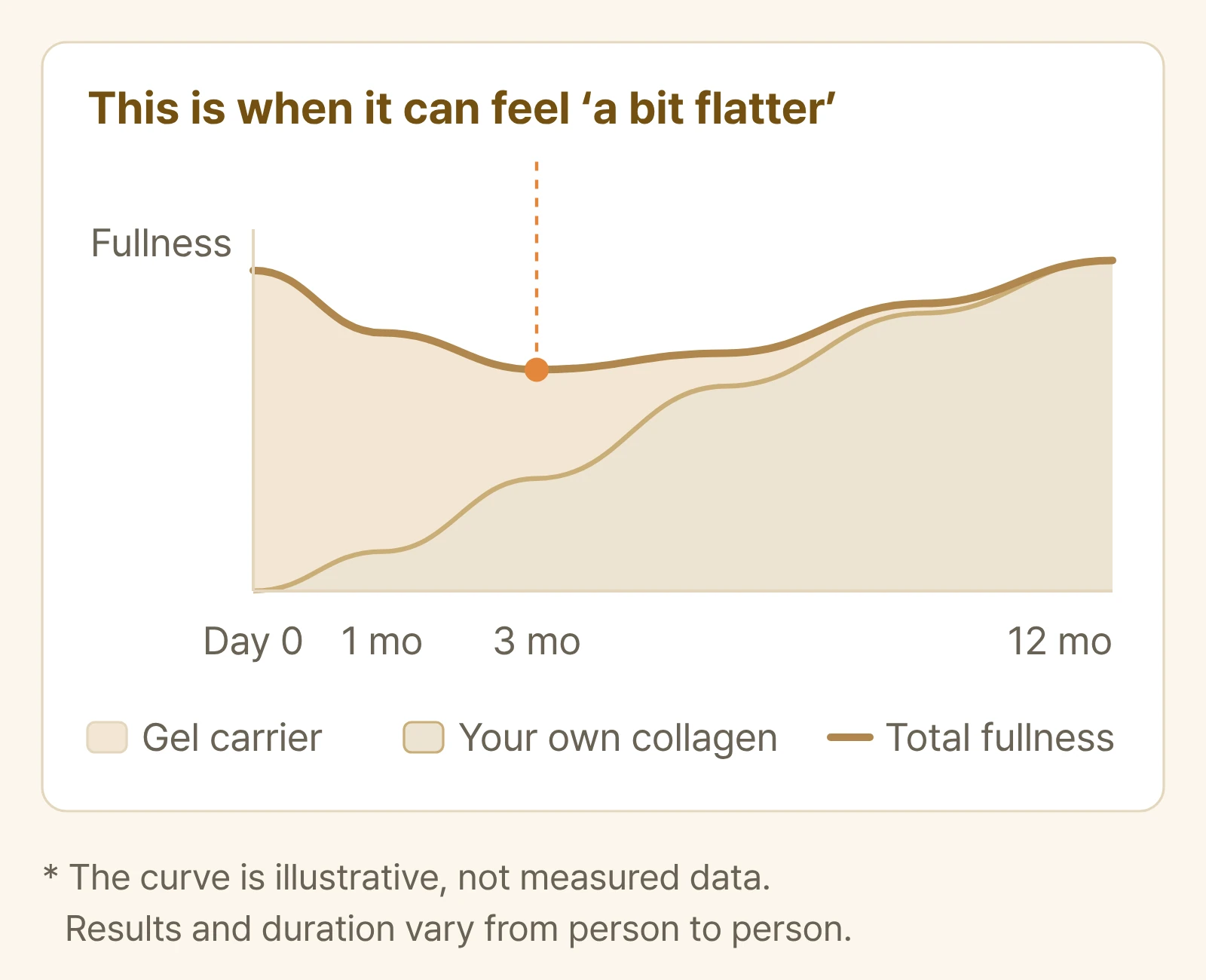
Meanwhile collagen is being built. The change from collagen appears gradually over about 3 months, so Radiesse is best judged a few months after treatment, not in the mirror the next week.
Does diluted Radiesse add volume or improve skin quality?
With diluted Radiesse, mainly skin quality.
Studies of diluted CaHA mostly report thicker, firmer skin: more collagen and elastin on biopsy, greater dermal thickness on ultrasound, and improvement in laxity and fine lines. Evidence for added volume is still limited to small case reports.
No randomized study has yet compared volume and skin quality side by side in the same people after diluted Radiesse on the face. So we describe the result as mainly thicker, firmer skin rather than added volume. In practice that tends to show as skin that pushes back a little more when pressed, and thin-looking skin gaining some substance.
How long does Radiesse last?
Usually about 12 months.
The gel is absorbed within months, but the collagen built in that time remains, so the change can outlast the gel. How long it lasts varies with skin thickness, the area treated and the dilution.
What does the research on diluted Radiesse show?
Radiesse has been in use for more than 20 years, so there is a reasonable body of histology and clinical work behind it. This article relies on three kinds of evidence, each with its limits.
- Expert consensus (de Almeida et al., 2019). Published recommendations on using diluted CaHA on the face and body, covering dilution and technique by skin thickness and area. It is the agreed opinion of an expert panel, not a clinical trial, and the meetings and writing were supported by the manufacturer.
- Neck study (Trindade de Almeida et al., 2023). 22 women received diluted CaHA in the neck, twice, 45 days apart. At day 120, 91% were rated improved on a global aesthetic scale, and dermal thickness on ultrasound had increased by an average of 15%. It was a small study without a control group.
- Biopsy study (Yutskovskaya et al., 2017). 20 people received diluted CaHA in the neck and upper chest. Type I collagen had increased at both 4 and 7 months, elastin also increased, and the changes tracked improvements in dermal thickness and elasticity.
A larger literature does not guarantee an individual result. Outcomes depend on skin thickness, area and dilution, and vary from person to person.
What should you know before getting Radiesse?
- It cannot be dissolved. Hyaluronic acid filler can be reversed with hyaluronidase. Radiesse is a different material and that does not work on it, which is why we inject it conservatively from the start: we would rather add a little later than have too much.
- We do not use it in the lips. The risk of nodules there is high, so lips are treated with hyaluronic acid filler.
- We do not recommend it under the eyes. The skin is thin enough for a nodule to show through. For under-eye hollows we suggest Juveacell or Juvelook Eye.
- It can show up on X-ray and CT. CaHA can appear white on imaging. It is not harmful, but mention the treatment before dental imaging or a facial scan so it is not mistaken for something else.
- Lumps are uncommon, not impossible. We inject slowly and evenly so the product does not clump, and dilute further and keep to the right layer where skin is thin.
In summary
Radiesse is licensed as a filler, but in Korea it is now mostly diluted and used as a collagen biostimulator. Diluted, it fills less and spreads wider, and fibroblasts attached to the calcium particles make collagen and elastin.
The slight fullness right after injection settles over a few weeks, and the change from collagen builds over about 3 months as thicker, firmer skin. It usually lasts about 12 months, with individual variation. Dilution and the areas to treat are decided at consultation, by skin thickness and area. You can see where it sits among our other options under collagen biostimulators.
References
- de Almeida AT, et al. (2019). Plastic and Reconstructive Surgery – Global Open. doi:10.1097/GOX.0000000000002160 (opens in a new window) · PMID 31044123
- Trindade de Almeida A, et al. (2023). Clinical, Cosmetic and Investigational Dermatology. doi:10.2147/CCID.S407561 (opens in a new window) · PMID 37255625
- Yutskovskaya YA, et al. (2017). Journal of Drugs in Dermatology. PMID 28095536 (opens in a new window)
- Nowag B, et al. (2023). Journal of Cosmetic Dermatology. PMID 36575882 (opens in a new window)
Keywords
FAQ
Location
Consultation
Have questions?
Find the treatment and settings that fit your skin — book a consultation at COCO Clinic.