
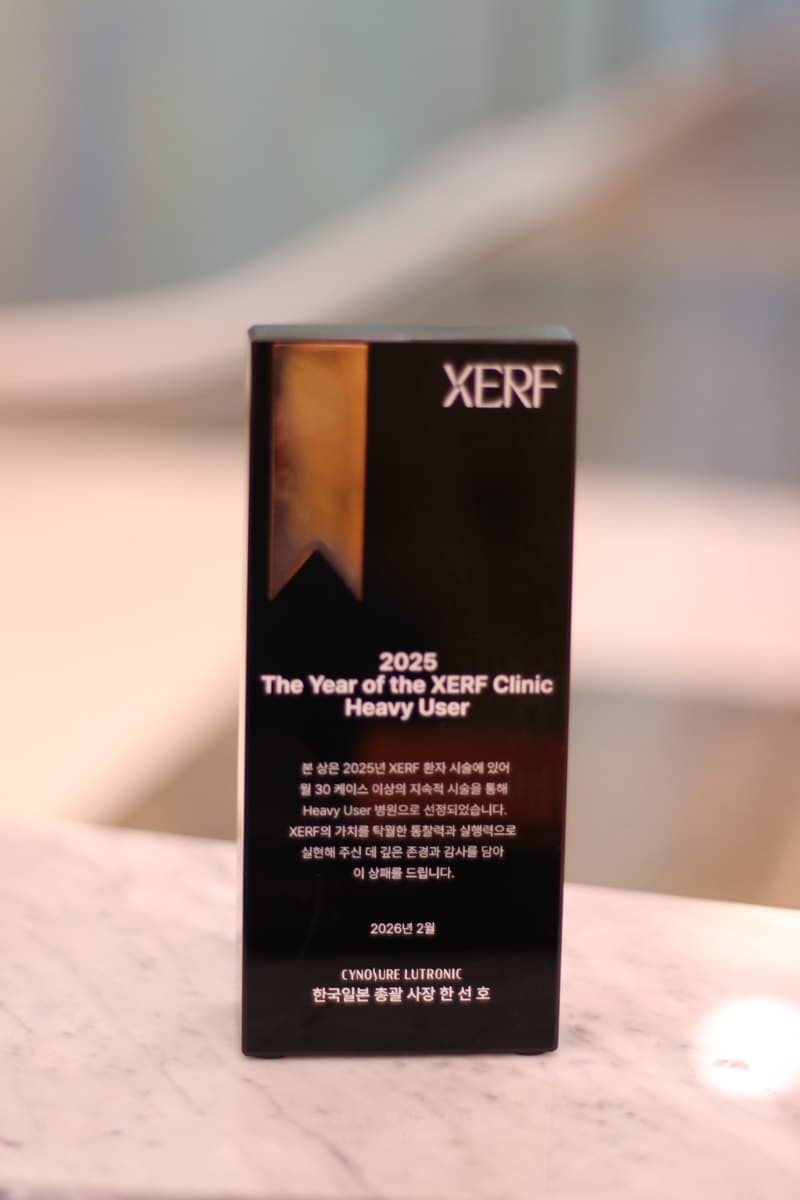
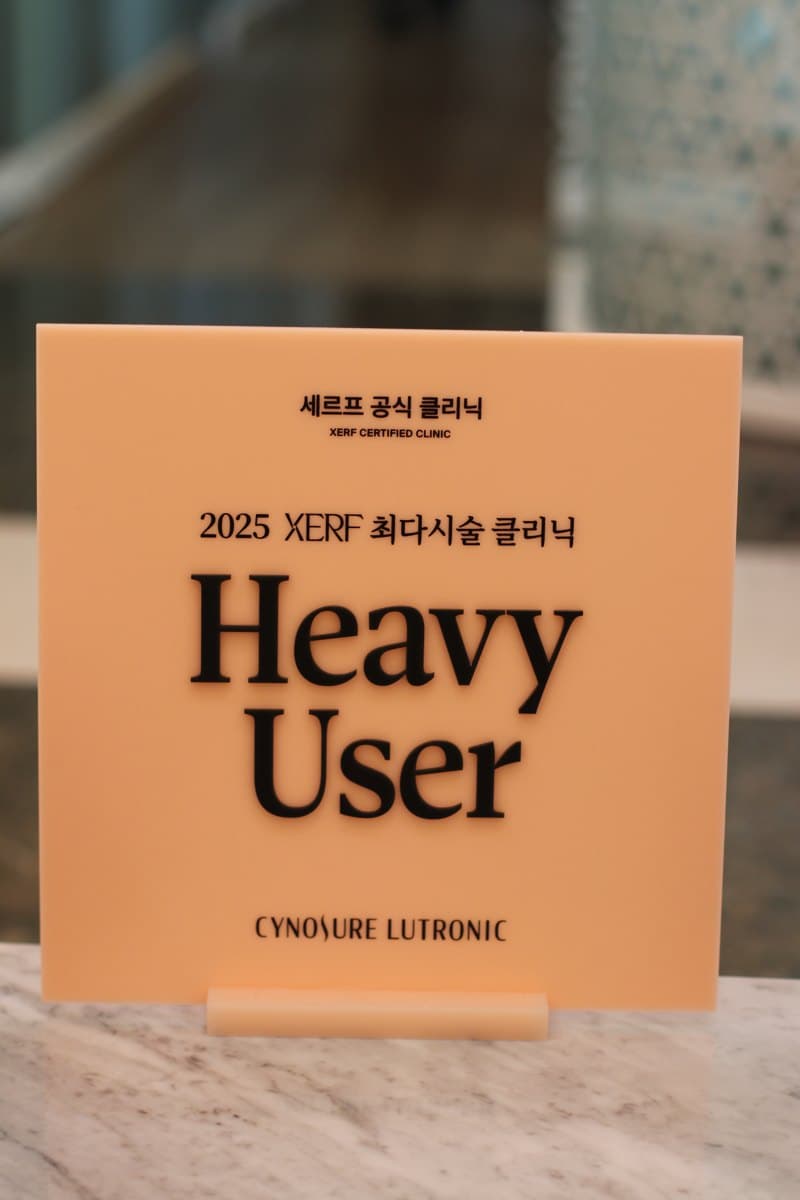
COCO Clinic has been named an official XERF Heavy User.
When people hear "Heavy User," they usually think of total usage volume. As a small clinic, we may not qualify on total volume. On a per-physician basis, however, I believe I am likely one of the doctors who has performed the most XERF treatments.
Here is the selection criterion stated by the manufacturer, Cynosure Lutronic:
"This award recognizes the clinic as a Heavy User for sustained treatment of more than 30 XERF cases per month throughout 2025." — President, Korea & Japan, Cynosure Lutronic (February 2026)
It isn't a one- or two-month spike — it's a certification you can only earn by treating consistently, every month, for a full year. To me, what matters more than the plaque itself is what it represents: that I have worked deeply with XERF.

What is XERF?
XERF is a monopolar radiofrequency (RF) lifting treatment that stimulates collagen production within the skin. Made by Cynosure Lutronic, it uses RF heat to act on collagen in the dermis and subcutaneous layer: immediately after treatment, collagen contraction produces a sense of firmness, and over the following two to three months newly formed collagen creates gradual lifting.
- Treatment is measured in shots — typically 300 / 600 / 900, with a dedicated Eye XERF for the periorbital area.
- Downtime is minimal; aside from slight redness right after treatment, normal daily activity is possible.
Theory and know-how built from the start
I have attended most of the major symposia since XERF was first launched. Building on that theoretical grounding and the know-how accumulated in actual practice, I continue to perform XERF treatments actively today.
Why having done it many times changes the result
Radiofrequency lifting is a treatment where results differ by operator even with the same device. The reason is more physical than you might expect.
In a porcine skin study, monopolar RF exposure brought dermal temperatures to roughly 50–70 °C while the skin surface stayed below about 42–45 °C (confirmed by infrared thermography). In other words, this is a treatment aimed at a fairly narrow window — heating only the dermis while protecting the epidermis. Too little energy and the collagen response is insufficient; too much and the epidermis takes the strain.
Yet skin thickness differs across the face, and the position of that window shifts with age, degree of laxity, and skin condition. Ultimately, where to add output and where to hold back, and how to distribute the shots, is what determines the outcome. The judgment built up by repeating many cases is exactly what shows here.
The device does not create the result. How the device is used creates the result.
Why XERF is special, part one — 6.78MHz & 2MHz dual frequency
XERF departs from the single wavelength (6.78MHz) long treated as a given in RF lifting, adding a 2MHz wavelength for dual-frequency delivery. Because lower frequencies penetrate more deeply (penetration depth is inversely proportional to the square root of frequency), XERF divides the roles of the two wavelengths on this principle.
- 6.78MHz concentrates heat locally along the dermis and the fibrous septa, refining firmness and texture across broad areas.
- 2MHz penetrates deeper and wider, heating into the subcutaneous fat layer with more volume.
Using both wavelengths together carries the thermal response through to the dermis–subcutis boundary, extending the remodelling of structural proteins such as collagen and elastin into the deep dermis and the fibrous septa. Because it refills layer by layer — from surface texture to the deep structural framework — it produces overall facial firmness, unlike ultrasound (HIFU), which stimulates at discrete points. This is precisely what XERF means by structural tightening.
Research on XERF itself bears this out. In a study using a porcine skin model and computational simulation, the dual-frequency approach induced deeper and more pronounced collagen and elastin remodelling across the dermis and fibrous septa than a single frequency, and the change grew more marked from day 7 to day 15 to day 30 after treatment. At the same time, adipocytes were preserved without damage — the structure was reinforced while the fat layer was left intact.
Why XERF is special, part two — Wave Fit Pulse: low pain, high energy
On top of this, the Wave Fit Pulse concept reduces the pain burden during treatment considerably.
Naturally, "less pain" raises the question of whether the intensity is simply lower. But the key to XERF is that the strength and quantity of energy are maintained while the momentary energy peak is removed, lowering only the pain. You can receive it in relative comfort — closer to a sensation of deep warmth — while sufficient energy is still delivered (perception varies between individuals).
How many shots are appropriate?
The official guideline is 600 shots per session. That said, there is no single correct answer.
- Younger skin with limited laxity: 300 shots can be enough to see results.
- Ages 40–50 and above, or where laxity has progressed: 600 shots is generally recommended.
- For tightening a broad area from forehead to neck: up to 900 shots may be needed.
The suggested cadence is one to two sessions per year at 600 shots. Sufficient shots and energy are needed for a meaningful result — but as noted above, we do not recommend more than is necessary.
When results appear
| Timepoint | What happens in the tissue | What you notice |
|---|---|---|
| Immediately after | Heated existing collagen contracts | Light firmness |
| 2–4 weeks | Wound-healing response begins remodelling | Change continues quietly |
| 2–3 months | New collagen and elastin build up | Firmness and texture improve in earnest (varies) |
| 6–12 months | Regenerated structure holds, then declines gradually | Time for maintenance |
There is no need to be disappointed if little has changed the day after treatment. Most of the actual change is built over two to three months.
Who it suits
- Those noticing loss of firmness and fine lines before visible sagging
- Those who find surgery or long downtime burdensome and want natural improvement
- Those sensitive to pain who found conventional RF treatments demanding
- Those who want overall facial firmness without hollowing of the cheeks
- Those planning steady maintenance once or twice a year
A checklist for receiving it safely
- Contraindications — Radiofrequency is contraindicated in principle if you have metal or electronic medical devices in your body (pacemaker, implantable defibrillator, and similar). It is also avoided during pregnancy, or when there is inflammation or infection at the treatment site.
- Spacing from other treatments — If you have recently had filler, threads, or Botox in the same area, treatment is possible but at least four weeks' spacing is advised, since heat may break them down faster or shorten their effect.
- Afterwards — Avoid saunas, steam rooms, strenuous exercise, and alcohol on the day of treatment. Thorough moisturising and sun protection during the collagen-building period affect the outcome.
Living up to the name "premium treatment"
If I had to name a drawback of XERF, it is that treatment takes a little longer from the physician's side. The Wave Fit Pulse design lowered the energy peak and the pain, but it also lengthened the time each shot takes.
From the patient's perspective, though, this is arguably a benefit — it means the physician is working through the treatment shot by shot with care. It suits the name "premium treatment" well.
What the evidence says
The literature below is provided to explain how the treatment works and does not guarantee individual results.
- A study analysing the thermal response of 6.78MHz and 2MHz through both computational modelling and histology found that 2MHz produced broader, deeper heating in adipose tissue while 6.78MHz created localised heating along the fibrous septa — with no adipocyte death observed. — Ko et al., Lasers in Medical Science, 2025 (opens in a new window)
- A histological study of the dual-frequency (6.78 + 2MHz) approach reported thickened, shortened collagen bundles after exposure, along with thickening of both superficial and deep fascial layers. — Hong et al., Skin Research and Technology, 2024 (opens in a new window)
- In a porcine skin model, dermal temperatures reached roughly 50–70 °C while the skin surface stayed below about 42–45 °C, with increases in collagen density and thickness at 30 days. — Park et al., Journal of Cosmetic Dermatology, 2024 (opens in a new window)
- A review of monopolar radiofrequency describes immediate partial contraction and denaturation of existing collagen from controlled dermal heating, followed by neocollagenesis over several months via the wound-healing cascade. — Kilmer et al., Lasers in Surgery and Medicine, 2025 (opens in a new window)
- In a randomised controlled trial, mean nasolabial-fold volume decreased significantly at 1, 3 and 6 months after a single treatment, with no serious adverse events reported. — Wang et al., Lasers in Surgery and Medicine, 2025 (opens in a new window)
The limits of this evidence deserve mention. Some of the studies above are based on porcine skin and computational modelling, and may differ from how human skin responds in practice.
Keywords
FAQ
Location
Consultation
Have questions?
Find the treatment and settings that fit your skin — book a consultation at COCO Clinic.