Hello, this is Dr. Jay, director of COCO Clinic.
In this post I will explain a substance that is indispensable to the recent anti-aging and longevity trends: NAD⁺.
If you are interested in anti-aging, you have probably heard the name NAD⁺ (Nicotinamide Adenine Dinucleotide). NAD⁺ is a "core fuel" that our body's cells absolutely need in order to produce energy.
Inside every cell of our body is an energy-producing factory, the mitochondria. For the energy systems you may have heard of in school — ATP, the TCA cycle — to run properly, a coenzyme called NAD⁺ is essential.
But as we age, NAD⁺ levels in the body drop sharply. Like an old smartphone battery, energy-production efficiency declines, the ability to repair damaged DNA weakens, and eventually cellular damage accumulates and shows up as "aging."
Why is NAD⁺ so important?
1. The core of cellular energy production and mitochondrial function
NAD⁺ is directly involved in the mitochondrial TCA cycle and oxidative phosphorylation, producing the energy we need to breathe, move, and think. In short, without enough NAD⁺, cells cannot properly make energy.
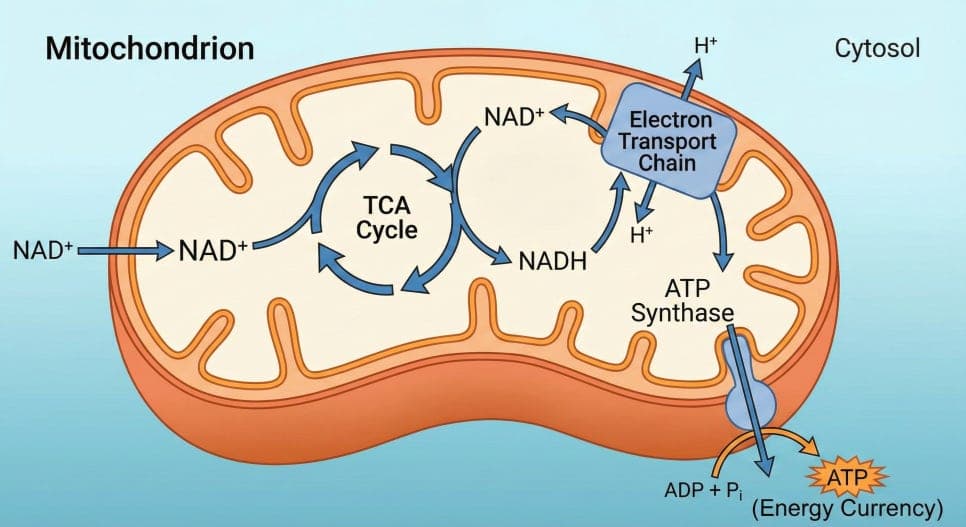
NAD⁺ participates in ATP (energy) production through the mitochondrial TCA cycle and electron transport chain.
2. Repairing damaged DNA (DNA Repair)
Our body has enzymes called PARPs (Poly ADP-ribose polymerases) that repair the DNA damage occurring every day. NAD⁺ is an essential material (substrate) for these PARPs to work. When NAD⁺ runs low, DNA repair does not proceed properly, and as a result aging progresses faster.
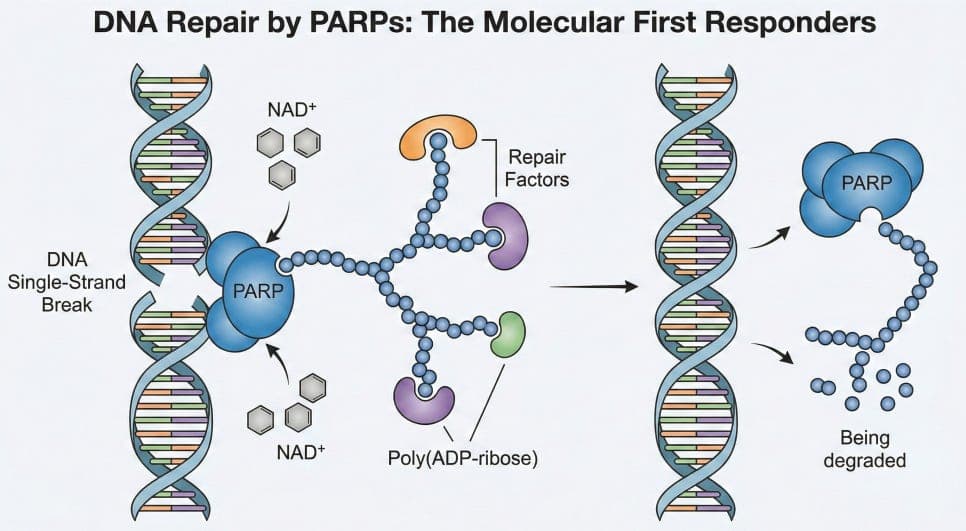
PARP consumes NAD⁺ to repair damaged DNA, acting as a molecular first responder.
3. The switch for the "longevity gene" sirtuin
Have you heard of sirtuins, the so-called "longevity genes"? Sirtuins are key protein enzymes that suppress inflammation, defend against cellular stress, and regulate the pace of aging. And the component absolutely required for sirtuins to be activated is NAD⁺.
Sirtuins — the key workers that regulate aging
If NAD⁺ is the "fuel," the worker that uses that fuel to actually slow aging and protect cells is the sirtuin. Sirtuins are also called "Guardians of the Genome," because they play such a central role in genome stability and aging control.
Summarizing the research, sirtuins have four main roles:
- Longevity: from yeast to mouse studies, lifespan extension has been observed in organisms with activated sirtuins.
- DNA repair: they detect and repair damaged DNA, preventing genetic damage.
- Metabolism: they improve insulin sensitivity and fat metabolism, keeping the body in a younger metabolic state.
- Cell protection: they reduce oxidative stress and chronic inflammation, lowering the risk of neurological and cardiovascular disease.
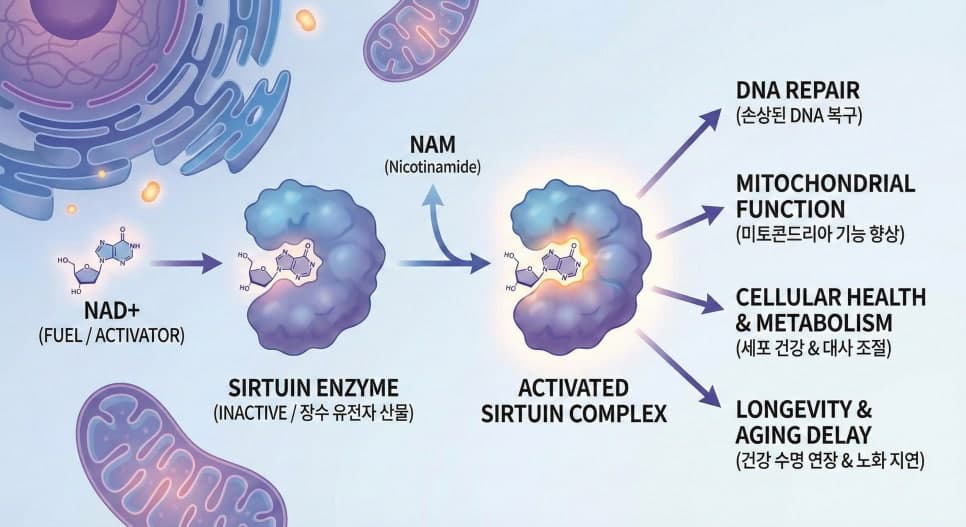
Using NAD⁺ as fuel, activated sirtuin contributes to DNA repair, mitochondrial function, metabolism, and lifespan extension.
But sirtuins have one decisive condition: they are NAD⁺-dependent enzymes. So as we age, NAD⁺ declines → the longevity gene sirtuin becomes less active → aging accelerates. This is the core of the biological mechanism of how we age.
What is the relationship between PARP and sirtuin?
As mentioned, PARP is essential for DNA repair. As an analogy, PARP is like a "119 emergency crew" that responds to acute DNA damage, while sirtuin maintains genome stability over the long term and is directly linked to lifespan extension.
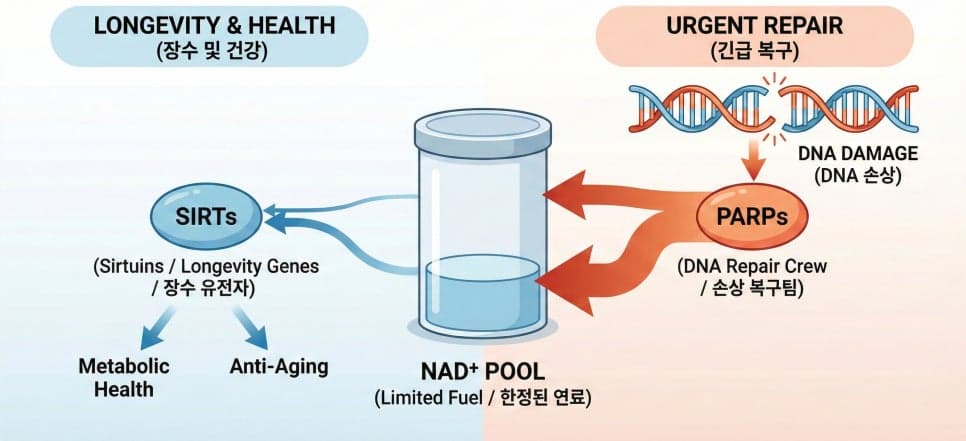
Sirtuins (longevity) and PARPs (DNA repair) compete over a limited NAD⁺ pool.
Because both consume NAD⁺, when PARP is over-activated, NAD⁺ is ultimately depleted and sirtuin activity falls — a competitive relationship. As aging progresses, DNA damage becomes more frequent, causing chronic NAD⁺ depletion and further accelerating the pace of aging.
So, the conclusion?
Ultimately, the key components for anti-aging and longevity are NAD⁺ and sirtuins — and among them, NAD⁺ acts as the core fuel. As aging progresses, the body's efficiency in producing NAD⁺ falls while demand rises, so NAD⁺ becomes persistently insufficient.
Therefore, replenishing NAD⁺ is essential. Because NAD⁺ itself has a large molecular weight and is barely absorbed by the body, you need to take a precursor form — NMN (Nicotinamide Mononucleotide) or NR (Nicotinamide Riboside). It exists in small amounts in food, but the amounts are so tiny that diet alone makes it hard to maintain sufficient levels.
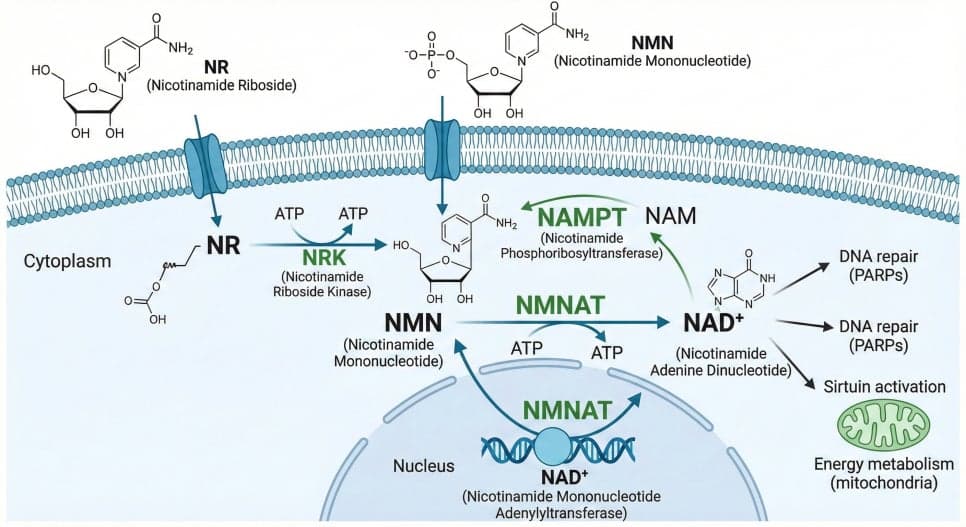
The biosynthesis pathway by which the NAD⁺ precursors NR and NMN are converted into NAD⁺ inside the cell.
That is why research into NAD⁺ precursor supplementation is very active, and taking it in supplement form is being proposed as a realistic alternative. This is the essence of the recently popular NAD⁺ supplements (NMN or NR). Covering the supplements themselves would get too complex, so I will write about that another time.
Thank you for reading this long piece.
Keywords
Location
Consultation
Have questions?
Find the treatment and settings that fit your skin — book a consultation at COCO Clinic.