Legato II is not a laser. It is a micro-plasma resurfacing treatment: instead of light at a set wavelength, it uses energy carried by ionized gas, or plasma, to open very fine channels in the skin. As those channels heal, new collagen forms, which can help depressed acne scars, enlarged pores and rough texture improve from within.
It is often searched for as "Legato 2 laser", but the energy it uses is different.
Is Legato II a laser?
No. A laser delivers light energy at a specific wavelength. Legato II delivers plasma, energy in the form of ionized gas.
It works at two levels. At the surface, fine vaporization can help with rough texture and uneven pigment. Deeper down, the heat it delivers prompts collagen and elastin remodeling.
"Resurfacing" can sound like the whole top layer of skin is removed. Legato II does not do that. It treats the skin point by point and leaves the skin between those points intact, and healing starts from that untouched skin.
Which acne scars does Legato II treat, and when is subcision needed?
Depressed acne scars are treated according to their shape.
Legato II is mainly a surface-regeneration treatment, so it suits shallow scars, enlarged pores, acne marks and surface inflammation from acne. Some scars are different: scar tissue under the skin tethers the surface and pulls it down, leaving uneven dips. Smoothing the surface alone can leave those contours behind. For these, skin subcision, which releases the tethering bands under the skin, is needed.
| Scar type | What it looks like | Approach we usually consider |
|---|---|---|
| Shallow scars, enlarged pores, marks | Texture and pigment at the surface | Legato II |
| Rolling scars | Wide, gently sloping dips, pulled down from below | Subcision + Legato II |
| Boxcar scars | Dips with sharp, defined edges | Subcision with laser or plasma |
| Ice pick scars | Narrow, deep pits | Legato II + Plexr, a plasma device |
That is why the two treatments are often combined, in separate visits. Subcision lifts the base of the scar, and Legato II refines the texture, pores and marks on the surface. We decide the combination at consultation, after looking at the shape and spread of your scars.
How does Legato II work in the skin?
It happens in three steps.
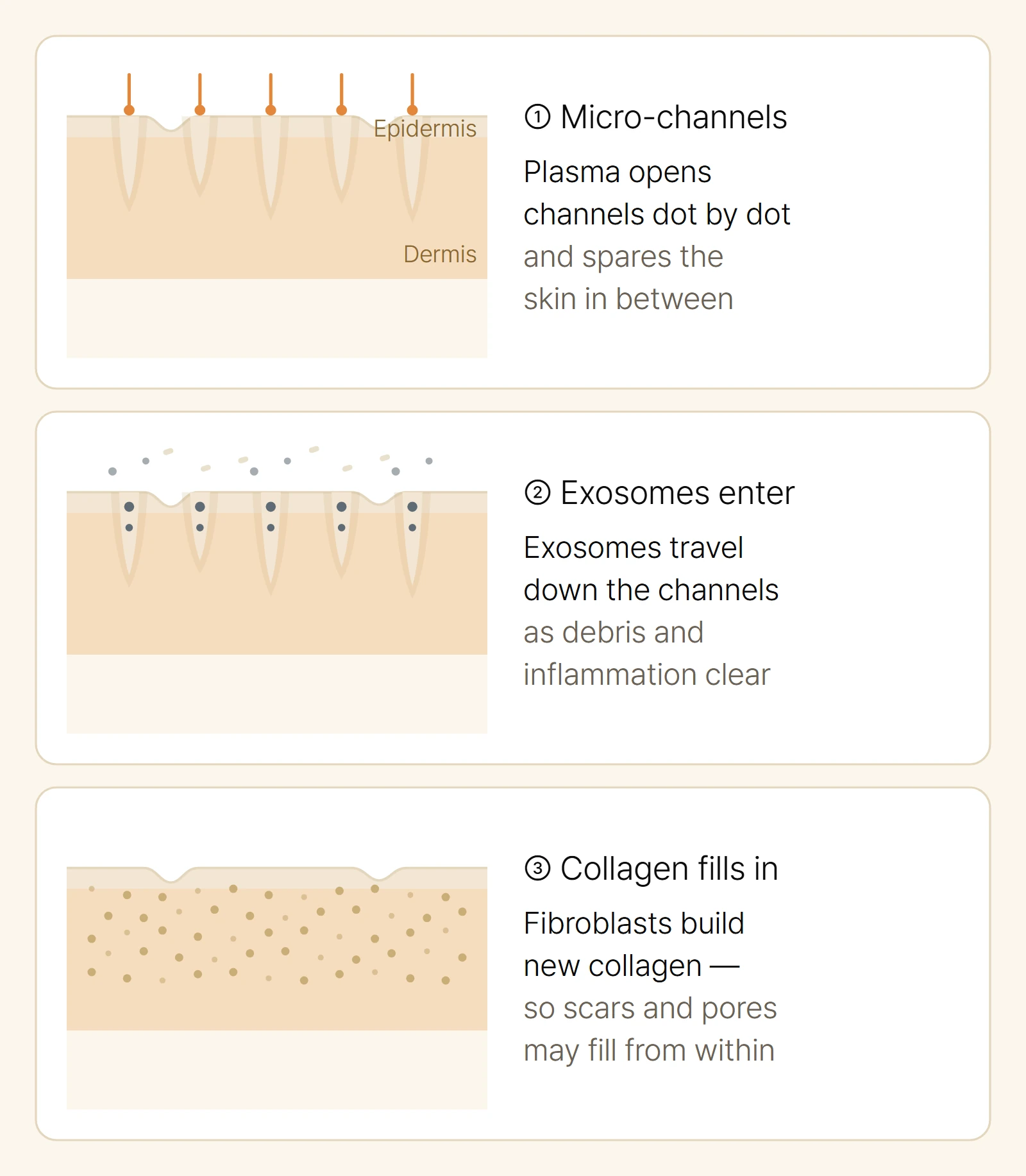
First, plasma energy creates tiny channels in the skin surface, point by point. The healthy skin around them is left as it is.
Second, right after the channels open, an exosome preparation is applied and driven in with ultrasound. It passes well through the open channels, where it supports soothing, regeneration and recovery of the skin barrier. On acne-prone skin, this step can also help clear surface inflammation and built-up dead skin.
Third, as the skin repairs these micro-injuries, fibroblasts are activated and make new collagen. This is the stage at which we hope to see depressed scars and pores fill in from underneath, and it builds gradually over several weeks. That is why many people notice more change a few weeks after treatment than in the days right after it.
Is the exosome step a stem cell treatment?
No. After Legato II we use Cytovesicle, an exosome preparation that combines exosomes derived from lactobacillus with exosomes derived from human adipose (fat) stem cells.
The ingredient list mentions stem cells, but no stem cells are placed in your skin. The preparation is not injected: it is applied to the skin and driven in with ultrasound. We apply it straight after the plasma step because that is when the open channels let it through.
How is Legato II done, and how long is the downtime?
A session takes about 60 minutes.
We apply numbing cream and wait long enough for it to work, then create the plasma channels, apply the exosome preparation and drive it in with ultrasound. We finish with Clarity II Genesis toning. Depending on your scars, we may add the Hollywood Spectra scar laser; what to add is decided on the day, by looking at your skin.
Pain is on the higher side. The numbing helps, but you may still feel stinging or heat during treatment, and how much varies with skin condition.
What recovery usually looks like:
- First 3–5 days: fine crusts form and fall off on their own. Do not pick them.
- About 1–2 weeks: overall recovery, including redness and swelling.
- Makeup: from 3–5 days after treatment.
- For 1 week: avoid saunas and jjimjilbang (Korean bathhouses), strenuous exercise and heavy drinking.
On the day of treatment, skip washing your face; from the next day, use a mild cleanser. Moisturizing and sun protection are especially important during recovery.
How many Legato II sessions will I need?
Scars and pores are rarely finished in one session.
Once the crusts and redness settle after 1–2 weeks, the skin texture usually starts to look more refined, and it can keep improving over the following weeks to months as collagen builds. Results tend to be good with a series of 3–5 sessions, 1–2 months apart. How many you need depends on how deep and widespread your scars are, and varies from person to person.
Who should wait or talk to us before Legato II?
Treatment may not be possible, or may need a consultation first, if any of these apply:
- You are pregnant or breastfeeding.
- There is an active infection or inflammation in the area, or a cold sore (herpes simplex) on the lips or skin.
- You tend to form keloids or hypertrophic scars.
- The same area recently had another resurfacing, laser or peel, or you have a photosensitivity condition.
In summary
Legato II is a micro-plasma resurfacing treatment. It opens tiny channels in the skin and supports new collagen as they heal. Its strength is surface texture, pores and marks; deeper scars that are pulled down from below are often treated together with subcision, in separate visits. Recovery takes roughly 1–2 weeks, most people need several sessions, and results vary between individuals. Start by finding out what type of scars you have. Treatment details and pricing are on our Legato II page.
Keywords
FAQ
Location
Consultation
Have questions?
Find the treatment and settings that fit your skin — book a consultation at COCO Clinic.