
Juvelook is a collagen booster: an injectable that combines PDLLA (poly-D,L-lactic acid) microparticles with hyaluronic acid. A filler works because the material stays in place. Juvelook works the other way: as the PDLLA particles slowly break down, they prompt your skin to make its own collagen.
That is why the change usually builds over 6–12 weeks rather than showing right away. Juvelook is best judged two to three months after treatment, not the next morning. Results and how long they last vary from person to person.
What is Juvelook, and is it a filler?
It is not a filler. Its two ingredients do two different jobs.
- Hyaluronic acid gives a hydrated feel straight after the injection and is absorbed within a few weeks.
- PDLLA is the part that matters. It stays after the hyaluronic acid has gone, and while it breaks down, your skin builds collagen.
So most of the dewy feel in the first days comes from the hyaluronic acid. When it fades after a few weeks, the treatment has not worn off. Collagen is still being built underneath.
How does Juvelook build collagen?
The PDLLA particles do not turn into collagen. They act more like a signal that tells the skin to make it.
It happens in four steps.
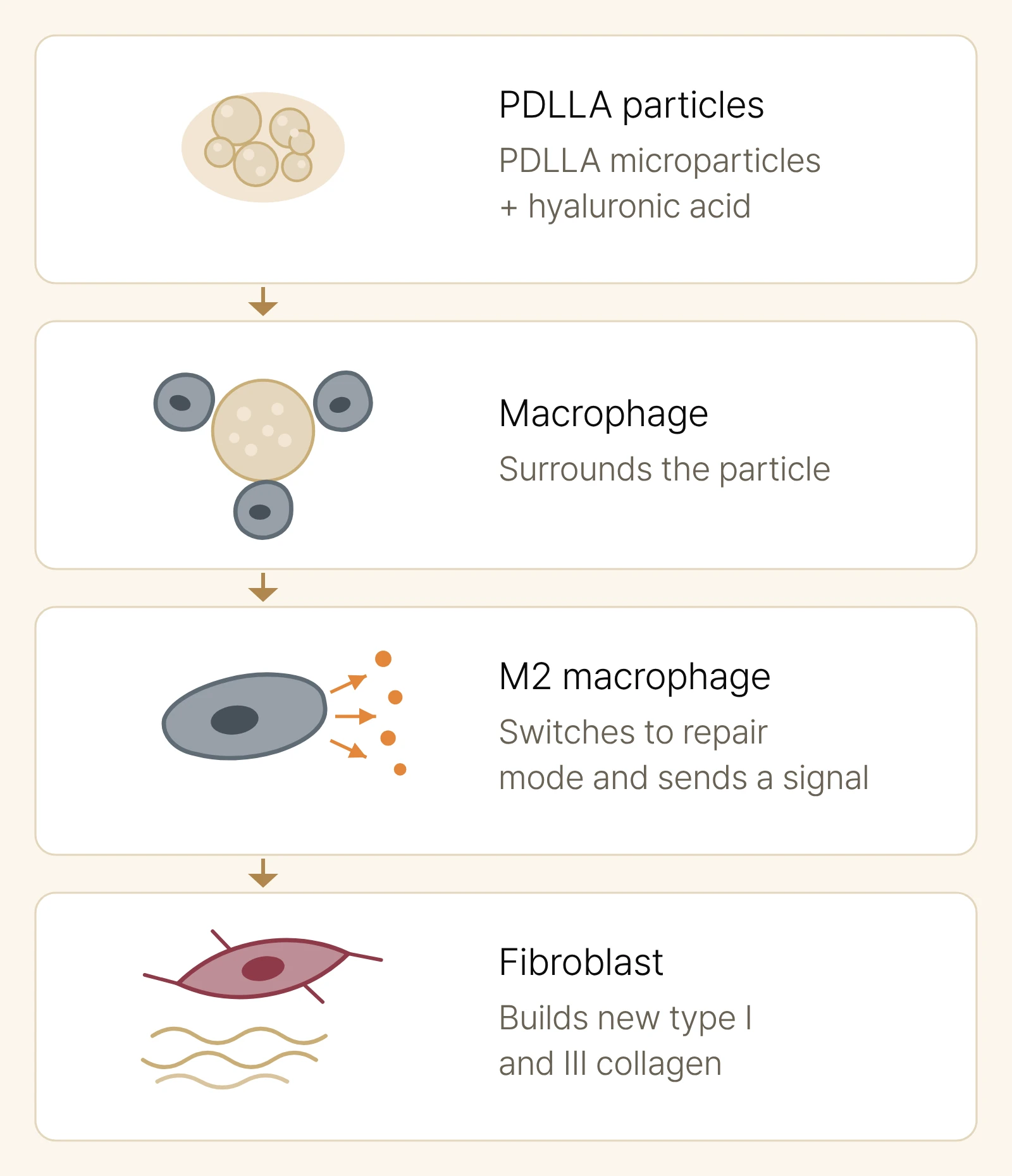
- PDLLA microparticles are placed in the dermis.
- Immune cells called macrophages recognize the particles and gather around them. The particles are too large to be swallowed, so the macrophages surround them instead.
- The macrophages switch to a repair-oriented type (M2) and release signaling molecules such as TGF-β1.
- Fibroblasts, the skin's collagen-making cells, pick up that signal and build new type I and type III collagen.
The key point is the conversation between the two cell types. Fibroblasts on their own do not increase collagen much; collagen rises when macrophages and fibroblasts signal to each other. Collagen also takes time to accumulate, which is why the change comes over weeks to months.
When will I see Juvelook results?
Expect the change to build gradually over 6–12 weeks.
- The first days: a little hydration from the hyaluronic acid, plus any swelling from the injections. Swelling usually settles within 2–3 days.
- The next few weeks: the hyaluronic acid is absorbed, so the early dewy feel fades. This is the point where people sometimes think it has stopped working.
- Around 6–12 weeks: the collagen built in response to the PDLLA can start to show as thicker, denser skin, to a degree that varies by person.
So the honest answer to "how long does Juvelook take to work" is two to three months. Judge it then, not in the mirror the week after.
How long does Juvelook last?
It depends on the product.
We use three Juvelook products, each for a different purpose:
- Juvelook Volume, for density and fullness across the face. It lasts about 12 months.
- Original Juvelook, for skin texture, scars and pores. It lasts about 6 months.
- Juvelook Eye, for thin areas around the eyes. It lasts about 6 months.
These are typical figures; skin thickness and the area treated change them, and they vary between individuals. The particles themselves do not stay. PDLLA belongs to the poly-lactic acid family, the same family of material as dissolvable surgical sutures, and it breaks down into lactic acid and then water and carbon dioxide. What remains for a while is the collagen built in the meantime.
The same family also includes PLLA, sold in the US as Sculptra. We do not offer Sculptra at our clinic; our poly-lactic acid option is Juvelook.
Which product suits you depends on what you are trying to change, whether that is wrinkles, thin skin that looks see-through, or the area under the eyes. We decide that at consultation, and adjust the dilution and the layer we inject into for each area.
Why does Juvelook take 2–3 sessions?
Because the collagen response comes slowly, putting the full amount in at once makes it hard to adjust to how your skin responds, and can raise the risk of overcorrection or clumping. So we usually split it into 2–3 sessions and check the change each time before deciding the next amount.
The spacing between sessions and the overall plan depend on the area and your skin thickness, and are set at consultation.
Can Juvelook cause lumps?
It can. Nodules, small lumps you can feel or see under the skin, are the main thing to watch for with any collagen stimulator.
Most come from particles clumping in one spot. That can happen when the powder is not fully dissolved, the mix is too concentrated, too much goes into one point, or it is placed too shallow.
Juvelook's PDLLA particles are small and rounded, designed to spread evenly in the tissue. That does not mean the risk is zero, so preparation matters as much as the product:
- We keep to the full hydration time. The product is dissolved for the specified time, and numbing cream goes on while it does. Cutting that time would make the appointment shorter but raise the risk of lumps, so we don't.
- We spread it thinly. Rather than concentrating it in one place, we place it in thin layers.
- You massage afterwards. For 5 days after treatment, massage the area 5 times a day for 5 minutes each, smoothing it evenly.
If you do feel a small lump later, massage that spot 3–5 times a day for 3–5 minutes, for 1–2 weeks. Early lumps often improve this way. If you were treated with us and it turns red, hurts, gets bigger, or is still there after 4 weeks, send us a photo. That applies after you have gone home, too.
Is Juvelook FDA approved?
No. Juvelook is made in Korea by VAIM. In Korea it is licensed by the Ministry of Food and Drug Safety as a tissue-repair biomaterial, for the temporary improvement of facial wrinkles in adults. It also carries European CE marking, but it is not FDA approved in the United States.
In clinics it is also widely used for skin density, pores and shallow scars, and those can change as collagen builds. That is clinical experience, not something the license covers. At consultation we separate what you are hoping for into those two groups, and explain what can and cannot be expected.
If deep, depressed scars are your main concern, a treatment that works on the base of the scar, such as subcision, may come first.
What does the research on Juvelook show?
The mechanism of PDLLA is described in some detail in animal and tissue studies. Studies in people are fewer.
- Animal study (Oh et al., 2023). In aged animal skin injected with the Juvelook formulation, collagen gene expression (types I and III) increased, and the authors proposed a pathway in which macrophages raised the growth and growth-factor output of fat-derived stem cells. It was funded by the manufacturer.
- Case report (Perez Willis et al., 2024). A patient developed a granuloma after PDLLA injection, treated with triamcinolone. It is a single case, but we mention it because it can happen, even if rarely.
Results in animals and tissue cannot be assumed to carry over to people unchanged, and individual results vary.
In summary
Juvelook is a collagen booster that combines hyaluronic acid with PDLLA microparticles. The hyaluronic acid gives early hydration and is absorbed within weeks; the PDLLA breaks down slowly and, through signals between macrophages and fibroblasts, prompts your skin to make collagen.
The change builds over 6–12 weeks, and a plan is usually 2–3 sessions. Juvelook Volume lasts about 12 months, and Original Juvelook and Juvelook Eye about 6 months, with individual variation. Lumps are possible, so full hydration, thin even placement and massage afterwards all matter. You can see where Juvelook sits among our other options under collagen boosters.
References
- Oh S, et al. (2023). Antioxidants. doi:10.3390/antiox12061204 (opens in a new window) · PMID 37371934
- Perez Willis KM, et al. (2024). Case Reports in Dermatological Medicine. doi:10.1155/2024/6544506 (opens in a new window) · PMID 38698953
Keywords
FAQ
Location
Consultation
Have questions?
Find the treatment and settings that fit your skin — book a consultation at COCO Clinic.